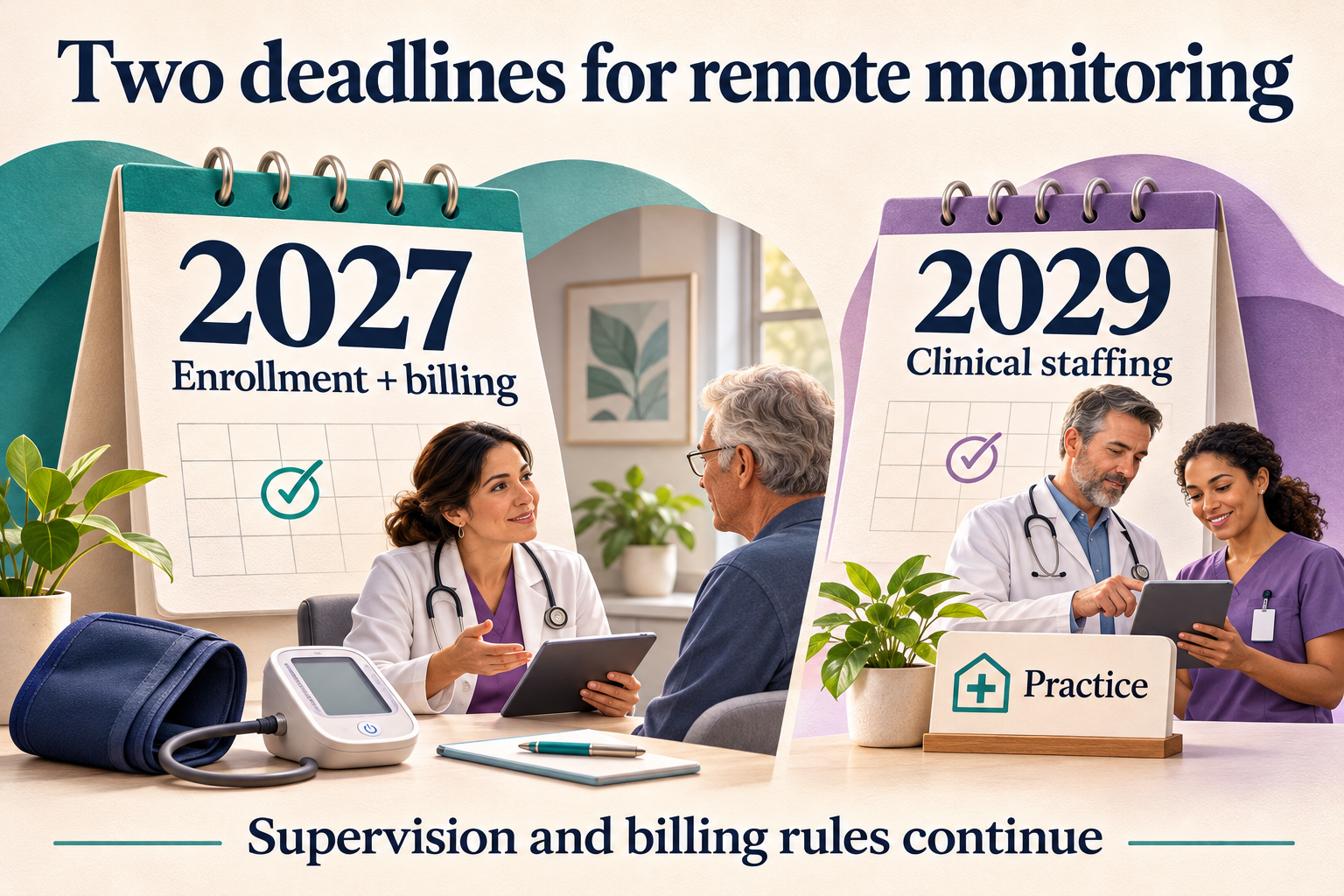
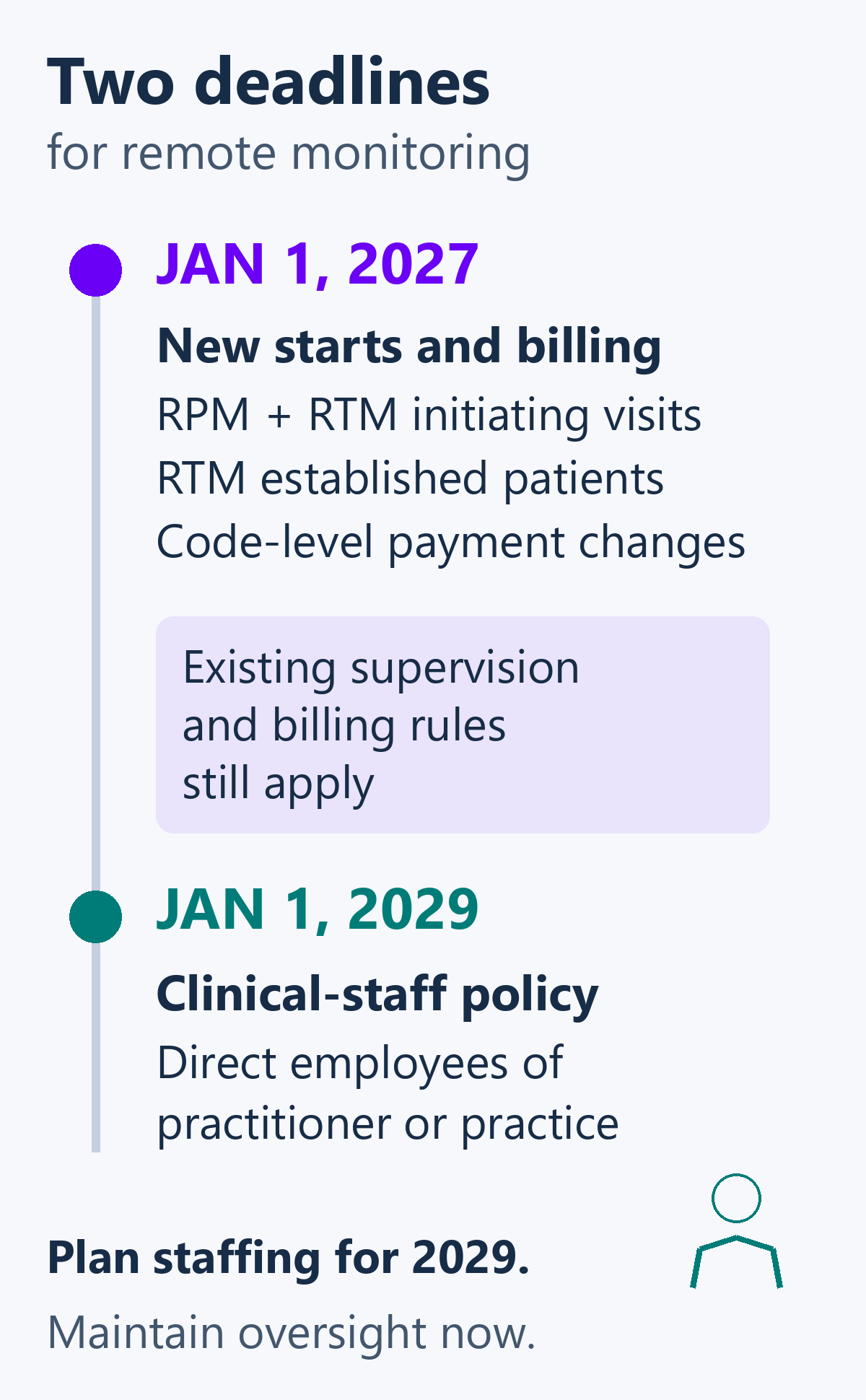
January 1, 2027 for enrollment and payment changes. January 1, 2029 for the clinical-staff employment requirement. Those are the two dates a practice needs to separate when preparing for CMS’s final 2027 Medicare Physician Fee Schedule rule.
For practices running remote physiologic monitoring (RPM) or remote therapeutic monitoring (RTM), this means preparing enrollment and billing now while planning a separate staffing transition. FairPath helps organize the monitoring work and records; the practice remains responsible for clinical care and claims.
CMS released its final-rule fact sheet on November 4, 2026. The underlying CMS-1848-F final rule was placed on public inspection that day and is scheduled for Federal Register publication November 9. Its stated regulatory effective date is January 1, 2027, with later implementation dates for specified policies. [1-3]
Key takeaways
- January 1, 2027: RTM must be furnished to established patients, and new RPM/RTM starts require a qualifying face-to-face initiating visit.
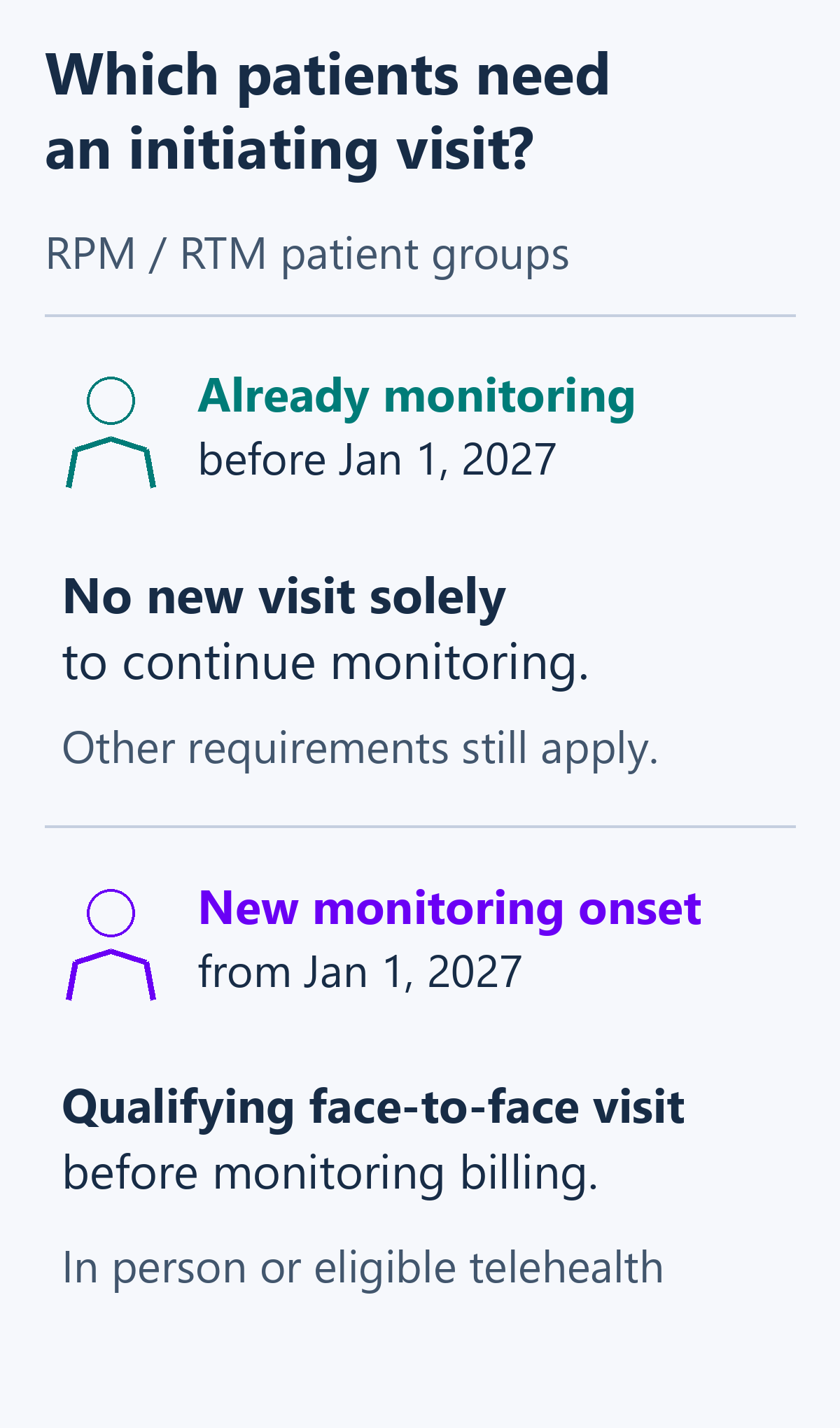
- Existing patients are treated differently: Beneficiaries already receiving remote monitoring before January 1, 2027 do not need a new initiating visit simply to continue, provided all other requirements are met.
- January 1, 2029: The practice-employed clinical-staff requirement begins. CMS plans additional guidance about acceptable staffing arrangements before then.
- Payment changes are code-specific: CMS finalized setup and device-supply valuation changes but did not finalize the proposed elimination of direct practice-expense inputs for six treatment-management codes.
- Primary care billing also changes: G2211 transitions to modifiers B1 and B2, with different eligibility rules and payment adjustments.
- FairPath supports the practice’s workflow: Software can organize monitoring records and work tracking; it does not replace the practice’s clinical workforce or determine whether a claim is payable.
What changed between the proposal and final rule?
The proposed rule would have started the clinical-staff employee requirement in January 2027. CMS finalized it with a two-year delay. The final rule also preserves direct practice-expense inputs for six treatment-management codes that CMS had proposed removing, and narrows the payment reduction for certain same-day office visits and procedures.
The four bundled remote-monitoring G-codes discussed in the proposed rule remain a comment solicitation, not adopted billing codes. CMS will consider those comments for possible future rulemaking. [2, pp. 290-301, 400-403]
Which monitoring patients need an initiating visit?
Beginning in 2027, the billing practitioner must initiate RPM or RTM during a face-to-face visit. The visit can be in person or through telehealth when the applicable Medicare telehealth requirements are met. CMS says CPT codes that do not involve a face-to-face visit by the billing practitioner, or are not separately payable under Medicare, cannot serve as the initiating visit. CMS separately clarifies that the initiating visit “can be separately billable, but does not have to be in all scenarios,” referring readers to its prior discussion of monitoring during global periods. Global-period and discharge scenarios therefore need specific review rather than a blanket extra-visit billing rule. [2, pp. 279-283]
RPM or RTM must be discussed during that visit, but it does not have to be the visit’s only purpose. CMS does not set a maximum interval between the initiating visit and monitoring activation, provided the required discussion occurred. Billing for monitoring cannot begin before the initiating visit has been furnished. [2, pp. 281-283]
CMS describes “onset” at the billing-provider level but does not otherwise define it. In that discussion, CMS also notes that same-specialty physicians in the same group must bill and be paid as though they were a single physician. [2, pp. 281-283]
After December 31, 2027, absent further legislation, telehealth initiating visits will be limited by the requirements of section 1834(m) of the Social Security Act that remain in effect. Do not assume current telehealth flexibilities are permanent. [2, p. 282]
For RTM, CMS also finalizes an established-patient requirement. A beneficiary may be considered established after meeting the initiating-visit requirements. For physicians and other qualified professionals, CMS points to professional services within the preceding three years from that professional or another professional of the same specialty in the same group. It separately discusses therapy professionals whose established relationship follows a therapy plan of care. Apply the definition and visit requirements appropriate to the professional furnishing the service. [2, pp. 278-283]
Do all current patients need another appointment?
No. A beneficiary already receiving remote monitoring before January 1, 2027 does not need an initiating visit just to continue those services, as long as the other requirements are met. CMS also says routine changes: such as a device change, clinical change or a change of billing practitioner within the same practice: do not by themselves require a separate initiating visit. [2, pp. 284-285]
CMS expressly discourages misuse of enrollment between publication of the rule and January 1, 2027, and reiterates that all remote monitoring must be reasonable and necessary. This exception is not a reason to accelerate enrollment. [2, p. 285]
For implementation, separate existing monitoring patients from new starts. For each new start, make the initiating visit, the monitoring discussion and the responsible practitioner easy to locate in the clinical record. This is a practical way to support the workflow, not a new CMS-mandated documentation form: CMS expressly declined to impose additional documentation requirements beyond those otherwise applicable to PFS services. [2, pp. 280, 283]
An example for the enrollment team
Consider two hypothetical patients in the same practice. One is already receiving RPM in December 2026. The other is being assessed for a new monitoring start in January 2027. The first patient does not need a new initiating appointment merely to continue. For the second, the team needs to establish that a qualifying face-to-face visit included the monitoring discussion before monitoring billing begins; that discussion can be part of a visit addressing other needs.
For both patients, the practice evaluates clinical appropriateness and satisfies the other applicable requirements.
What does the 2029 staffing deadline mean for the practice?
CMS delayed the employment requirement to give practices time to hire, train and reorganize their monitoring workflows. Beginning January 1, 2029, the finalized policy requires clinical staff furnishing the affected RPM/RTM services to be direct employees of the practitioner or the practitioner’s practice; contracting out that clinical-staff work to third-party companies will not be allowed after that time. CMS says it will issue further guidance clarifying appropriate clinical-staff arrangements before implementation. [2, pp. 285-291]
Through December 31, 2028, existing incident-to and other billing requirements still apply. CMS specifically warns that inadequate practitioner oversight or clinical integration can mean the billing criteria are not met. The delay provides transition time, while responsibility for the care remains with the billing practitioner. [2, p. 291]
Technology purchasing is a separate question. CMS says the policy permits vendors who supply technology without supplying third-party staff time. Practices may obtain devices, software, connectivity, hosting, cybersecurity, implementation support, technical assistance and interoperability services from outside companies. Using a technology platform leaves the clinical-staff employment requirement intact.
In describing the policy, CMS says direct employment does not mean clinical staff must always be physically in the office. It leaves the remote-monitoring supervision requirements and the relevant text of 42 CFR 410.26 unchanged. [2, pp. 286-288]
Practical implication: Review clinical staffing separately from technology purchasing. Identify who performs the clinical work, who employs them and how the billing practitioner supervises and uses that work. Build a transition plan around the 2029 date while leaving room for CMS’s promised clarification of complex staffing arrangements. Do not treat a software contract as evidence that clinical staffing requirements are satisfied.
How should a practice rebuild its reimbursement forecast?
The rule’s conversion factors are lower than in 2026. A conversion factor translates geographically adjusted relative value units (RVUs) into a payment amount; it is not the total payment for an individual service.
| Practitioner category | CY 2026 conversion factor | CY 2027 conversion factor | Approximate change |
|---|---|---|---|
| Qualifying alternative payment model participant (QP) | $33.5675 | $32.9548 | −1.83% |
| Non-QP | $33.4009 | $32.6286 | −2.31% |
These are CMS’s estimated PFS conversion factors in Tables D-B1 and D-B2, not the separate anesthesia factors. CMS removes the temporary 2.50% increase that applied only in 2026, then applies the −0.12% budget-neutrality adjustment and statutory updates of +0.75% for QPs or +0.25% for non-QPs. [2, pp. 1971-1972]
Build the forecast from the actual codes, location and setting. RVUs, practice-expense allocations and service mix also change the result, so applying −2.31% to every 2026 payment would produce an unreliable estimate.
What changes for remote-monitoring codes?
The detail below comes from the rule itself. The fact sheet broadly describes valuation updates as finalized “as proposed,” but the rule expressly retains treatment-management inputs that the proposal would have eliminated. [1; 2, p. 297]
- Setup and device supply: CMS finalizes the proposed work and direct practice-expense inputs for 99445, 99453, 99454, 98975, 98976, 98977, 98984 and 98985.
- Certain RTM device-supply codes: CMS crosswalks 98978 and 98986 to 98977 so they share the same practice-expense RVU. The rule says 98978 and 98986 become actively priced in 2027 rather than contractor priced.
- Treatment management: CMS does not finalize the proposed elimination of direct practice-expense inputs for 99470, 99457, 99458, 98979, 98980 and 98981. That does not mean their final dollar payments are unchanged; other parts of the payment calculation still matter.
- Significant RVU reductions: The statutory phase-in applies to many remote-monitoring codes. For codes that are not new or revised, CMS describes a maximum one-year RVU reduction of 19%. The phase-in does not apply to 98978 and 98986, which CMS treats as new or revised because they were formerly contractor priced. These are RVU provisions, not a guarantee that a practice’s payment or revenue decline is capped at 19%. [2, pp. 296-297]
CMS also notes a planned January 2027 AMA Relative Value Scale Update Committee (RUC) practice-expense review of all 19 RPM/RTM codes, with information to be considered for future rulemaking. That is not a separate adopted payment change, and 2027 values should not be assumed permanent for later years. [2, p. 296]
Use the CMS final-rule addenda and payment files to model the codes your practice actually bills. Keep device costs, connectivity, clinical labor and practitioner time separate so you can see which part of the program changes financially. A single national “monthly RPM reimbursement” figure would conceal those differences.
What else changes for primary care billing?
G2211 becomes B1 and B2
CMS replaces the separate G2211 longitudinal-care add-on with modifiers applied to an office/outpatient or home/residence evaluation and management (E/M) visit, including a telehealth visit when all other requirements are met:
- B1: A 16% increase to the associated E/M payment for qualifying longitudinal-care services.
- B2: A 32% increase for qualifying services furnished by eligible practitioners participating in a Medicare Shared Savings Program accountable care organization (ACO) or as Participant Providers in a Long-term Enhanced ACO Design (LEAD) Model ACO. CMS also addresses ACO Primary Care Flex participants through their Shared Savings Program participation. These adjustments are calculated as 16% or 32% of the associated E/M service’s total RVUs, respectively. [1; 2, pp. 325-344, 1975]
Use B1 and B2 rather than the proposal’s MOD1 and MOD2 placeholders. An ACO relationship alone does not make every visit eligible: B2 is voluntary and limited to the specified ACO arrangements and qualifying longitudinal care. CMS allows its use for qualifying services to beneficiaries who are not assigned to the ACO as well as those who are. The percentages adjust the associated E/M service, not RPM reimbursement or total practice revenue.
Billing teams should update claim templates and check eligibility rather than automatically appending a modifier. Practices using RVU-based compensation should also examine CMS’s B1/B2 adjusted-RVU file. CMS acknowledges that this change affects how compensation systems may account for the work. B2 claims remain included in ACO assignment, benchmark and performance-expenditure calculations; the higher adjustment is not excluded from reconciliation. [1; 2, pp. 325-344]
Same-day E/M and procedures: the final policy is narrower
CMS finalizes a 20% reduction, paying the affected services other than the highest-valued service at 80%, when a separately identifiable office/outpatient E/M visit is furnished with a 0-day global procedure. The E/M visit is identified with modifier 25, and the policy applies to the same physician: or a physician of the same specialty in the same group: furnishing the services on the same day.
That is narrower than the proposal’s 50% payment and inclusion of 10- and 90-day global procedures. CMS also declined to exempt RPM/RTM initiating visits from this reduction, so an enrollment workflow and its financial forecast need to account for the same-day rule when applicable. [1; 2, pp. 284, 400-403, 1975]
Other chronic-care and behavioral-health changes
CMS also finalizes separate coding and payment for shared medical appointments, with an additional-time add-on and a limit of one session per week per beneficiary. It increases work RVUs for the Psychiatric Collaborative Care Model (CoCM) and updates behavioral health care manager labor rates. [1; 2, pp. 319, 369]
For advance care planning, new G0572 and G0573 describe services furnished by clinical staff under the billing practitioner’s direct supervision; CPT 99497 and 99498 report time personally spent by that practitioner. CMS allows both code sets to be reported together when each set’s time threshold is met. CMS also permits practitioner time to be combined with clinical-staff time for G0572/G0573 when clinical-staff time alone would not meet the threshold. [1; 2, p. 560]
How FairPath fits the practice’s implementation
The practice remains responsible for deciding whether monitoring is appropriate, furnishing clinical care, supervising staff and supporting claims. Technology should make the relevant work and records easier to find rather than substitute for those responsibilities.
| Function | What your team owns | What FairPath records or surfaces |
|---|---|---|
| Enrollment and monitoring setup | Clinical selection, initiating-visit assessment and required consent | Monitoring enrollment and workflow records |
| Ongoing monitoring | Review, patient communication and clinical decisions | Monitoring data and work tracking |
| Monthly billing preparation | Code selection, verification of requirements and claim submission | Recorded monitoring activity for the team to review |
A clinical workflow staffed by the practice’s own employees can use outside technology. CMS distinguishes technology vendors from vendors that supply clinical-staff time; the rule does not certify any particular product or vendor as compliant. [2, p. 287]
Prepare enrollment and billing now; plan staffing separately
Bring the enrollment, clinical and billing leads together around the actual work: identify which patients are continuing monitoring, confirm the initiating-visit process for new starts, and rebuild payment estimates from the 2027 codes and values. Update E/M claim templates for B1/B2, and include the same-day procedure policy in the forecast.
Assign the staffing review a separate January 2029 deadline and revisit the staffing map when CMS publishes its promised guidance.
Sources
Related FairPath guides
- Analysis of the CY 2027 RPM/RTM proposed rule, for the proposal’s background and rationale.
CMS and Federal Register primary sources
- CMS: CY 2027 Medicare Physician Fee Schedule Final Rule fact sheet, dated November 4, 2026.
- CMS-1848-F: Final rule, Federal Register Public Inspection PDF. Page references use the PDF’s 1-based page count: pp. 272-301 for remote monitoring; pp. 325-344 for B1/B2; pp. 400-403 for same-day E/M and 0-day globals; p. 560 for advance care planning; pp. 1971-1972 for conversion factors; p. 1975 for the payment-impact summary.
- CMS-1848-F regulation page and supporting payment files. Identifies the final-rule status, November 4 display date and November 9 publication date, and links the addenda and implementation-related payment files.