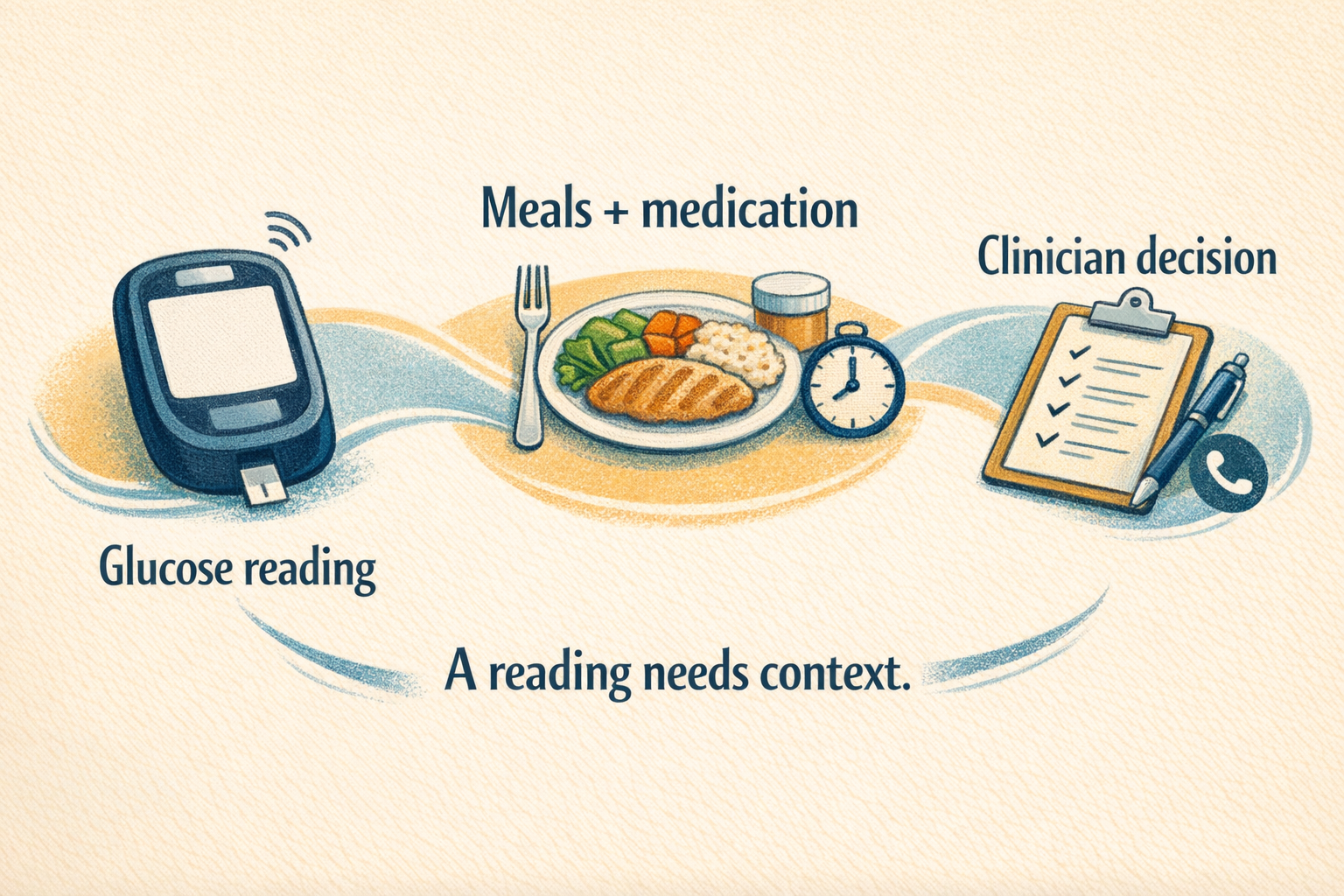
A connected glucose reading becomes useful when someone knows what to do with it. For a medical practice, diabetes remote patient monitoring (RPM) connects home measurements to a defined clinical question, an accountable care team, and documented follow-up. FairPath helps practices organize enrollment, incoming data, review queues, communication, and billing evidence while their clinicians own the care.
Short answer: Diabetes RPM uses qualifying connected glucose data to help a practice manage a patient between visits. A working program needs medical necessity, an appropriate device, automatic data transmission, a patient-specific action plan, clinical review, and separately supported billing. A connected glucometer or continuous glucose monitor (CGM) does not automatically make every service eligible for an RPM claim.
Key Takeaways
- Select patients because between-visit glucose information can change management—not because they meet one universal A1c cutoff.
- Connected glucometers and CGMs create different measurement, supply, coverage, and professional-service questions.
- Define who reviews results, who responds to symptoms, and who can authorize medication changes before enrollment.
- Qualifying device days, management time, and live communication are separate evidence requirements.
- FairPath connects the operational record; the practice supplies the workforce and retains clinical and billing authority.
Which Patients Are a Good Fit for Diabetes RPM?
Start with the question the treating practitioner wants to answer. Is the patient responding to a treatment change? Are there recurring low readings, wide variability, missed testing, or barriers that office visits do not reveal?
A useful candidate has both a clinical reason for connected monitoring and a realistic way to participate. Review testing technique, language, vision, dexterity, cognition, supplies, connectivity, and caregiver support. A low A1c can coexist with problematic lows; a high A1c alone does not establish that this particular service is appropriate.
Write down the goal, expected review frequency, responsible practitioner, and criteria for continuing or ending monitoring. Medicare RPM requires a medically necessary monitoring service for an acute or chronic condition, not diagnosis-only enrollment.
Connected Glucometer vs. CGM: Choose the Clinical and Coverage Pathway
| Question | Connected glucometer | Continuous glucose monitor |
|---|---|---|
| What is measured? | Discrete blood-glucose readings | Interstitial-glucose readings and trends |
| What does the patient do? | Perform fingerstick testing under the prescribed plan | Use sensors and the appropriate reader or connected system |
| What needs checking? | Technique, strips, lancets, timing, automatic upload | Sensor use, product limitations, transmission, supply coverage and professional interpretation |
| Main billing trap | Treating manually typed values as automatically transmitted device data | Assuming CGM coverage means RPM can also be billed automatically |
For either device, confirm the exact model, intended use, medical-device qualification, transmission method, patient attribution, and usable reports. A device's marketing label is not that analysis.
CGM supply coverage and RPM services are different questions. Under Medicare's Glucose Monitors coverage policy, CGM coverage has specific initial and continued criteria. Insulin treatment or a qualifying history of problematic hypoglycemia is only part of the coverage assessment; training, prescription, practitioner visits, and other requirements also matter.
Map device and supply payment, professional CGM services, RPM, and any other care program before billing. Do not count the same interpretation, work, or time twice, and do not present RPM as automatic payment for CGM supplies.
Choose the information you need
A spot reading is not a continuous trend
Both can inform care. Their data and benefit pathways differ.
Connected glucometer
Blood glucose at prescribed testing times. Check technique and automatic upload.
Continuous glucose monitor
Interstitial-glucose readings and trends. Check sensor use and supply coverage.
Build the Glucose Action Plan Before the First Reading
The practitioner-approved plan should establish what the patient measures, when results are reviewed, which symptoms or trends need attention, and how the patient reaches the team. Include confirmation instructions for questionable readings, medication authority, missed-data handling, and after-hours arrangements.
Low-glucose concerns need a patient-specific response plan that the patient and caregiver understand. The NIDDK guide to low blood glucose explains why medication, meals, activity, and illness can affect risk. Use that clinical context rather than applying one dashboard cutoff to everyone.
Consider an illustrative patient whose diabetes medication was recently changed and whose readings begin running lower than their usual pattern. The transmitted value shows what was measured, not why. When a team member reaches the patient, the patient explains that they have been eating later since the medication change. Meal timing matters because, as NIDDK notes, delayed or skipped meals can raise the risk of low blood glucose with some diabetes medicines. The team member records the report, asks about symptoms and how the medication is being taken, and routes the information to the treating practitioner. The practitioner decides whether the plan needs clarification, a further assessment, or a treatment change, and the record shows who followed up and what the patient was told.
Technical problems take a different route. If readings stop arriving, the team checks the connection and the patient's ability to test before interpreting the gap as a clinical pattern. When a questionable value arrives, the reviewer checks technique and the patient-specific confirmation instructions. Clinical concerns go to the accountable practitioner; permitted staff carry out their part of the plan within scope.
The record should connect the assessment to the communication and follow-up. If the patient was asked to contact the team or obtain another assessment, someone needs to verify that happened. An alert marked reviewed is less useful than a note that explains the decision and the completed next step.
The patient must know the actual review window. A connected device does not itself provide continuous emergency surveillance.
Illustrative medication-change example
The reading starts a conversation
The next decision depends on what happened around the measurement.
Verify the reading
Confirm patient, timing, technique, and upload.
Ask what changed
Patient reports eating later since the change.
Decide and follow up
Treating practitioner decides, instructs, and owns follow-up.
What Should the Practice Document?
A useful note tells the treatment story: what changed, what information was reviewed, what the clinician concluded, and what happened next. “Glucose reviewed” is not enough.
Keep device and clinical evidence distinct. Retain the monitoring purpose, consent and cost-sharing discussion, device and benefit-pathway review, education, dated source data, quality exceptions, assessment, authorized treatment decisions, communication, and continued need. Time records identify the person, activity, duration, and service to which the work belongs.
In the meal-timing example, the clinical note records the patient report, the practitioner decision, and the follow-up. Separately, the billing reviewer checks which setup, supply, or management requirements were actually met. The clinical decision does not automatically unlock every code.
Medicare Diabetes RPM Billing in 2026
Diabetes does not have its own universal RPM payment rate. The same code-specific framework applies, supported by the patient's clinical record.
| Service | 2026 pathway | Evidence to review |
|---|---|---|
| Initial setup and education | 99453 | Supported setup/education and at least 2 days of monitoring within 30 days; reported once per episode of care |
| Device supply | 99445 for 2–15 days or 99454 for 16–30 days | Qualifying collection/transmission days in the applicable 30-day period |
| Treatment management | 99470 for the first 10 minutes or 99457 for the first 20 minutes | Qualifying work during the calendar month and required live interactive communication |
| Additional management | 99458 | Each supported additional 20 minutes after 99457, subject to reporting rules |
The CMS 2026 final rule makes the short- and full-duration pathways alternatives, not additive charges. Management codes do not depend on reaching 16 days of device data. Live communication contributes to management time but need not occupy the entire reported interval; CMS adopted the CPT requirement for live, interactive communication with the patient or caregiver and did not list further exclusions, so confirm that the communication you count was live and interactive.
Before claim release, confirm eligible personnel and supervision, distinct time, payer requirements, and overlap with CGM-related services, APCM, CCM, or other care. Adding a blood-pressure cuff does not automatically create a second device-supply payment. Use current locality and setting data for reimbursement, not an undated national estimate.
2026 reporting pathways
RPM: two different clocks
Track qualifying days and eligible clinical work separately.
2–15 qualifying days OR 16–30 qualifying days
First 10 minutes OR first 20 minutes
Live, interactive communication counts toward total time.
Where FairPath Fits in a Practice-Run Diabetes Program
FairPath organizes the program records and work queues; it does not interpret glucose data or make treatment decisions. It supports multiple manufacturer integrations and bring-your-own-device workflows; the practice still verifies the exact model, data connection, and service pathway.
| Function | What your team owns | What FairPath records or surfaces |
|---|---|---|
| Patient and device fit | Medical necessity, selection, device and CGM benefit review | Enrollment status, device information and supporting records |
| Setup and action plan | Consent, education, glucose goals and response instructions | Setup history, practice-entered plan and communication records |
| Review and follow-up | Review windows, symptom assessment and authorized treatment decisions | Incoming data, review queues, documented actions and follow-up status |
| Billing preparation | Qualifying days, permitted work, code selection and overlap decisions | Activity, time, communication and evidence for human review |
Your team provides the clinical workforce and makes treatment and billing decisions. The FairPath platform keeps enrollment, review, communication, and activity connected so the team can see what is complete and what still needs attention.
Frequently Asked Questions
What A1c qualifies a patient for RPM?
There is no single universal A1c threshold. The treating practitioner documents why connected data are medically necessary and likely to affect this patient's management.
Can CGM and RPM be used together?
Sometimes. A CGM that automatically transmits data can be part of an RPM program, but CGM supply coverage, professional CGM services, and RPM are separate services with separate requirements. Check the exact device, current coding edits, and payer policy, and do not count the same interpretation, work, or time toward more than one service.
Can patients enter glucose readings manually?
Manual readings can support care, but they do not by themselves meet an RPM device pathway requiring automatic collection and transmission.
When should diabetes RPM end?
Reassess when the treatment goal is met, readings no longer change management, participation needs redesign, or another care pathway is more appropriate. Enrollment is not a reason to continue indefinitely.
Related FairPath Guides
- Remote Patient Monitoring: A Practical Guide
- 2026 RPM Coding Changes: A Complete Practice Guide
- Advanced Primary Care Management