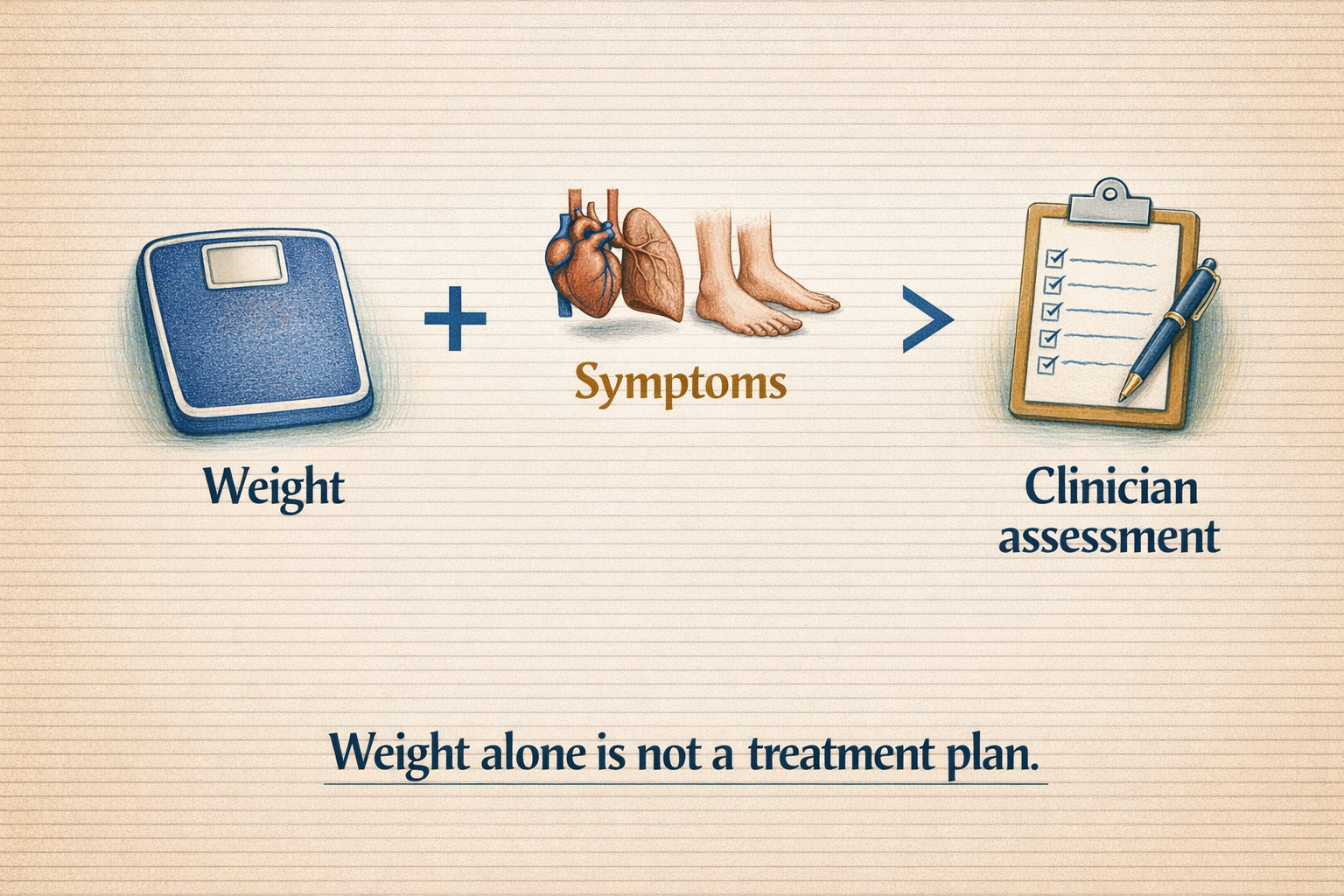
A connected scale can show a change in weight. It cannot determine why that change happened or who should respond. A useful heart-failure remote patient monitoring (RPM) program connects reliable measurements with symptom assessment, an individualized action plan, and a clinician who owns the next decision. FairPath helps practices organize enrollment, incoming data, review queues, communication, and billing evidence while the practice remains responsible for clinical care.
Short answer
RPM for heart failure uses a qualifying connected medical device, often a scale, to transmit physiologic data for a medically necessary monitoring service. The practice needs more than readings: patient education, a reliable review process, individualized escalation instructions, documented clinical follow-up, and evidence supporting the particular services billed. Device data do not replace symptom assessment or emergency care.
Key takeaways
- Choose patients because a monitoring plan can inform a clinical decision, not because every heart-failure diagnosis automatically warrants enrollment.
- Interpret weight alongside symptoms, measurement conditions, medication use, and the patient's clinician-defined baseline.
- Assign one accountable clinician and a backup pathway, especially after discharge or when multiple teams are involved.
- Device reporting periods, treatment-management time, and payment for other care-management services are separate questions.
- FairPath can organize the operational record and surface follow-up gaps; the practice supplies the clinical workforce and judgment.
Start with the clinical question
Heart failure is not a single monitoring scenario. A patient returning home after a hospitalization may need a different review cadence from someone with stable symptoms and a long-established treatment plan. Ask what the team expects to learn and what it could reasonably do with that information.
Useful questions include whether symptoms or weight trends suggest a need for assessment, whether the patient understands the treatment plan, and whether barriers are preventing consistent medication use or measurement. Enrollment should have a documented purpose and a reassessment point. A scale that adds work without changing care may not justify continued monitoring.
Assess participation before shipping equipment. Can the patient stand safely on the scale, see the display, understand instructions, and use the available connection? Would a caregiver help, and does the patient consent to that involvement? A person who cannot use a scale safely needs a different clinical plan, not pressure to produce measurements.
Choose a scale that fits the patient and the data pathway
Verify the exact device and transmission arrangement. Medicare RPM uses medical devices meeting the FDA definition and digital transmission of physiologic data. A consumer scale, a photograph of a display, or a manually entered weight should not be assumed to satisfy the requirements for a device-supply claim.
| Check | What the team should establish |
|---|---|
| Safe use | Appropriate capacity, stable placement, accessible display, and the patient's ability to step on and off safely. |
| Consistent measurements | Clinician-approved instructions for timing, clothing, and scale placement so readings are comparable, plus a record of changes in routine or equipment. |
| Reliable transmission | A tested connection from the patient's home to the intended review system, with a plan for outages. |
| Data integrity | Patient identity, timestamps, units, duplicates, and unexpected values are identifiable and reviewable. |
| Support | Someone owns setup, troubleshooting, replacements, and reassessment when the device no longer fits the patient. |
A cellular connection may reduce some setup burdens, but coverage still needs testing at the patient's home. A Bluetooth or Wi-Fi pathway may work well when the patient can maintain the required phone, app, or network. Connectivity is a practical selection issue, not proof of Medicare eligibility.
Put symptoms next to the weight trend
Weight change can be relevant to fluid status, but it is not a diagnosis. The reverse also matters: symptoms can worsen without a large weight change, so the plan should tell patients which symptoms to report regardless of the scale reading. Measurement error, different clothing, changes in intake, and other clinical factors can affect a reading. The National Heart, Lung, and Blood Institute's heart-failure guidance advises discussing how often to weigh and when to report changes with the treating clinician. It notes that weight gain, ankle swelling, or increasing shortness of breath may mean fluid is building up.
Use clinician-defined weight thresholds and response instructions rather than a universal weight-gain cutoff or automatic diuretic adjustment in a generic patient workflow. The treating clinician should establish the patient's baseline, reporting thresholds, symptom questions, and response instructions. Medication decisions may require review of blood pressure, renal function, electrolytes, other medications, and the broader clinical picture.
The patient should know the difference between sending a routine reading, contacting the practice about a concerning change, and seeking urgent or emergency care. State review hours and the after-hours route plainly. An RPM program should not imply continuous emergency surveillance unless that service actually exists.
Read the signal in context
Weight + symptoms + a clinician-defined plan
A connected scale is useful when the team can interpret what changed.
Comparable weight
Safe, stable placement. Consistent conditions and patient baseline.
Patient context
Symptoms, measurement changes, and the individual action plan.
Clinical assessment
Interpret the change and communicate authorized instructions.
Build an escalation pathway that closes the loop
A useful response begins by confirming the patient, timestamp, and measurement conditions. A surprising value may reflect a change in routine or a device problem; it may also be a reason for clinical assessment. Keep the original reading and document any correction so the next reviewer can understand the sequence.
The reviewer then adds the symptoms and other information specified in the patient's plan. The point is not to complete a universal questionnaire but to give the accountable clinician the context needed to decide what happens next. Urgent symptoms follow the urgent-care instructions, without waiting for the routine review queue.
Once the clinician decides, the team communicates the instructions and checks that the patient or caregiver understands them. The note identifies who authorized a treatment change and what follow-up was arranged. A backup pathway matters when the usual clinician is unavailable: the patient should not be left between two teams, each assuming the other will respond.
Closure is the final piece. If a recheck, assessment, or phone contact was planned, the team verifies whether it happened. That turns a stream of scale readings into an accountable care process rather than a list of alerts.
A missing reading deserves a different workflow from a concerning reading. It might mean connectivity trouble, illness, difficulty using the device, or a decision not to participate. Resolve the reason before treating missing data as nonadherence.
Two signals, different first steps
No reading is not the same as a concerning reading
Choose the follow-up that matches the information actually available.
Reading missing
Check connection, safe device use, illness, and participation. Resolve the cause.
Reading received · review needed
Verify the measurement, add symptoms, and route under the clinical plan.
Make post-discharge ownership explicit
Consider a patient returning home with a revised treatment plan. The discharge team may have documented the intended medication schedule and follow-up, while the primary-care and cardiology offices each receive part of the record. Before connected weights begin arriving, establish which practitioner owns the monitoring response, what baseline and instructions the team will use, and how the other clinicians will receive important updates.
The discharge plan should identify the receiving practitioner by name and contact, identify the backup clinician, and assign the receiving team responsibility for confirming follow-up. The patient needs one clear route for a monitoring concern and a clear after-hours alternative. The backup team needs enough information to respond when the usual clinician is unavailable. Naming that receiver and confirming the handoff prevents an alert from moving between offices without anyone completing the assessment.
Agree whether cardiology or primary care furnishes the RPM service before devices ship. If home health, a skilled nursing stay, or another program is already collecting similar data, decide who responds to which signals so the patient does not receive conflicting instructions. CMS remote-monitoring guidance specifies one practitioner billing per patient in a 30-day period; reconcile the proposed arrangement before enrollment.
A discharge does not automatically make every subsequent contact separately billable. Review transitional care, chronic care, advanced primary care, and other services under the applicable payer rules. Distinct services need their own required elements, and the same work or time cannot be counted twice. A change in care setting or coverage may also require reassessing the billing arrangement.
Illustrative post-discharge workflow
A handoff needs a named receiver
Connect the discharge plan to the team responsible for the next response.
Transfer the plan
Discharge team sends baseline, medication plan, and follow-up instructions.
Name the owner
Receiving practitioner: record name and contact. Identify the backup clinician.
Confirm closure
Receiving team checks patient understanding and records completed follow-up.
Keep the clinical record and billing evidence distinct
Clinical documentation should explain why the patient is monitored, what the team observed, and what happened next. Billing documentation should support the selected service rather than infer eligibility from the number of dashboard entries.
Record the monitoring purpose, consent and applicable cost-sharing discussion, device and transmission pathway, education, relevant readings and symptoms, assessment, authorized decisions, communication, and follow-up. For time-based services, identify the person, activity, duration, and service allocation. Administrative device troubleshooting is not automatically reportable treatment-management time.
Medicare RPM billing for heart failure in 2026
The 2026 Medicare Physician Fee Schedule final rule added shorter-duration options. They are alternatives to the corresponding longer-duration codes, not extra payments for the same work.
| Service | Code and reporting distinction |
|---|---|
| Initial setup and patient education | 99453, reported once per episode of care, when its setup and education requirements are met and monitoring includes at least 2 days of data in a 30-day period. |
| Device supply and data transmission | 99445 for 2–15 qualifying days or 99454 for 16–30 qualifying days in the 30-day period; do not report both for the same period. |
| Treatment management | 99470 for the first 10 minutes or 99457 for the first 20 minutes in the calendar month, with the required interactive communication; do not stack the two base codes. |
| Additional treatment-management time | 99458 for each additional 20 minutes following 99457, when the requirements are satisfied. It is not added to 99470. |
Treatment-management codes are not contingent on meeting the 16-day device threshold. At least one real-time, interactive communication with the patient or caregiver is required; it contributes to the management time but need not make up the entire total. Count each minute once.
Verify qualifying personnel, supervision, medical necessity, payer policy, and code combinations before submitting a claim. Adding a blood-pressure cuff does not automatically create a second device-supply payment. Reimbursement depends on the payer, locality, payment adjustments, and applicable patient responsibility—not a universal national revenue figure.
Where FairPath fits
A monitoring platform should make responsibility easier to see, not move clinical responsibility away from the practice.
| Function | What your team owns | What FairPath records or surfaces |
|---|---|---|
| Enrollment and device fit | Medical necessity, patient participation, consent, and safe device selection. | Enrollment status, device information, and outstanding setup tasks. |
| Review and routing | Individualized thresholds, review coverage, symptom assessment, and escalation decisions. | Incoming data, review queues, assigned work, and unresolved follow-up. |
| Communication and closure | Clinician-authorized instructions, patient understanding, and completed follow-up. | Communication and activity records supporting the workflow. |
| Billing preparation | Code selection, eligible personnel, supervision, distinct service allocation, and claim approval. | Recorded activity and potential evidence gaps for the team to reconcile. |
FairPath supports multiple device-manufacturer integrations and bring-your-own-device workflows; the practice verifies the exact model, transmission pathway, and fit for the service being reported. The practice employs or contracts with the clinical team, and the FairPath platform keeps the operational record that team uses. Software does not prescribe, establish coverage, or guarantee payment.
Frequently asked questions
Does every patient with heart failure qualify for RPM?
A diagnosis alone does not establish medical necessity, practical suitability, or all billing requirements. Select a patient because a defined monitoring plan can inform care, then verify the device and payer requirements.
Is a connected scale enough?
No. A scale supplies data. The practice must also establish the monitoring purpose, education, review process, clinical response, and documentation appropriate to the services provided.
Should the program automatically change a diuretic dose?
No generic workflow should make that assumption. Medication changes require an authorized clinician's decision or a properly established patient-specific treatment plan within applicable professional rules.
When should monitoring be reassessed?
When the clinical purpose changes, participation becomes impractical, repeated data problems undermine interpretation, the care setting changes, or the team can no longer provide the planned response. Document whether to continue, modify, or discontinue the service.
Related FairPath Guides
- RPM implementation and workflow guide
- 2026 RPM CPT coding changes: 99445 and 99470
- APCM requirements and workflow guide