AI Assistance in Annual Wellness Visits: Preparation and Professional Review

AI prepares information. The health professional reviews the plan and completes the applicable AWV work.
A medication appears on the chart, but the patient says they stopped taking it. In this illustrative AWV example, AI can organize the two accounts and flag the discrepancy. The professional verifies the information before using it in the patient’s prevention plan.
AI can help prepare an Annual Wellness Visit (AWV), including collecting questionnaire responses, reconciling information, suggesting screenings, and drafting a personalized prevention plan. The health professional still reviews the information, completes the applicable visit elements, and approves the plan. CMS does not currently accept AI use for routine measurements or cognitive assessments. [1]
This guide explains those component-level boundaries for practices and pharmacy partners. For eligibility, initial versus subsequent visit selection, and the overall visit sequence, use the Annual Wellness Visit Operational Guide.
What CMS says about AI assistance
CMS’s AWV guidance uses the term “Super Intelligence” (SI), also called artificial intelligence. Its first-visit and subsequent-visit tables describe specific ways AI can assist. These descriptions are not permission to replace the health professional or submit a claim for an AI-only visit. [1]
For example, the first-AWV table says:
“SI can draft a personalized prevention plan, including individualized health advice and referrals to health education or preventive counseling services or programs, for you to review and approve.” [1]
That distinction matters: preparing a draft and approving the patient’s final plan are different tasks. The coverage regulation continues to define the AWV as a service furnished by a qualifying health professional and to specify its required content. [2]
Where AI can help with first and subsequent AWVs
The following summarizes roles expressly described in both CMS tables. The professional establishes information at the first AWV and updates it at subsequent visits, as applicable. [1]
| Visit component | AI assistance described by CMS | Professional work that remains |
|---|---|---|
| Health risk assessment (HRA) | Administer the questionnaire, collect updated history or provider information, and summarize information before the visit. | Review and augment the HRA, address missing responses, and consider the findings in the visit. |
| Medical and family history | Extract information from the electronic medical record. | Review and verify the information; establish or update the history during the visit. |
| Medications, supplements, and other substances | Reconcile the current list. | Review and verify the list, resolve discrepancies, and complete any applicable clinical review. |
| Providers and suppliers | Reconcile the current list. | Review and verify who is involved in the patient’s care; establish or update the list. |
| Written screening schedule | Generate recommended screenings. | Review and prioritize the recommendations during the visit and finalize a patient-specific schedule. |
| Personalized prevention plan | Draft individualized advice and referrals to health education or preventive counseling services or programs. | Review and approve the plan, including advice and referrals appropriate to the patient. |
| Voluntary advance care planning (ACP) | Help prompt discussion about future care, advance directives, caregiver identification, and patient priorities. | Conduct the discussion with the patient at the patient’s discretion. An AI prompt does not replace that conversation. |
An HRA collects the patient’s self-reported information. AI assistance should preserve that source rather than turn a prediction into a patient response. The HRA must also meet the applicable content and communication requirements, including the needs of patients with limited English proficiency or health literacy needs. [2]
CDC’s patient-centered HRA framework also emphasizes accessible administration, including language needs, disability accommodations, and alternatives to digital-only completion. Offer a way for patients to answer or clarify questions that they can understand and use. Its sample HRA is optional; the framework addresses accessible participation rather than AI performance. [3]
The first and subsequent tables are not identical
For the first AWV, CMS also describes AI administering the professional’s selected depression screening instrument or escalating responses for review before the visit. It describes AI asking appropriate functional and safety screening questions, or using the professional’s questionnaire, before the visit, with results reviewed during the visit. [1]
Those separate rows and AI annotations are not repeated in the subsequent-AWV table. The updated HRA still includes psychosocial risks and daily functioning; relevant findings still need attention. Do not assume the tables give identical component-level permissions. The coverage regulation specifies use of an appropriate depression screening instrument at the first AWV for people without a current depression diagnosis. [2]
The first table also repeats general HRA and information-summary language under risk factors and substance-use screening. Its opioid-review annotation describes medication-list reconciliation. These annotations do not say AI can independently diagnose a substance use disorder, select treatment, or finish the opioid review. For a patient with a current opioid prescription, that review includes potential opioid use disorder risk, pain severity and the treatment plan, information on non-opioid options, and referral when appropriate. [1, 2]
An omitted AI annotation does not, by itself, settle every possible use of software. It also does not establish permission for autonomous completion of that component.
CMS requires measurements and cognitive assessment outside AI preparation
CMS states in both visit tables:
“We don’t currently accept SI use for measuring weight, waist circumference, blood pressure, or other routine measurements. This may change in the future as SI technology advances.” [1]
Practices still need to obtain the applicable measurements. The first AWV includes height, weight, body mass index or appropriate waist circumference, blood pressure, and other appropriate routine measurements. Subsequent AWVs include weight or waist circumference, blood pressure, and other appropriate routine measurements. [1, 2]
CMS separately states:
“We don’t currently accept SI use for cognitive assessments.” [1]
The cognitive assessment requires direct observation with consideration of information from the patient, family, caregivers, and others. AI questionnaire administration or a generated summary does not replace that assessment. Advice about cognition in a draft prevention plan does not override this restriction. [1, 2]
A recorded device measurement and an AI-generated measurement are different things. The AI guidance does not establish that every home, pharmacy, remote, or device-based measurement arrangement meets AWV requirements. Practices must determine how they will obtain and document the required measurements for the actual visit, including when using telehealth.
Why AI summaries need source checking
A 2025 study in PLOS Digital Health evaluated summaries of 100 adult emergency-department encounters from one institution. In the studied GPT-4 configuration, 42 of 100 summaries contained hallucinations—information not supported by the source—and 47 omitted clinically relevant information. Only 33 were error-free across the evaluated domains. The error categories overlapped; these percentages describe summaries, not the share of individual statements that were wrong. [4]
The study evaluated summaries drafted from existing clinician notes, not AWVs or live patient interviews. Its results depended on the model, prompt, source notes, and de-identification process. It does not establish an AWV error rate or the performance of a current AI service. It does show why a fluent summary should be checked against its source rather than accepted on wording alone. [4]
NIST’s voluntary generative-AI risk-management profile recommends reviewing and verifying sources and citations in AI outputs during predeployment evaluation and ongoing monitoring. That is general risk-management guidance, not a CMS-mandated AWV checklist. [5]
For AWV preparation, compare medication names and doses, allergies, history, and proposed follow-up with the patient’s responses and available records. If a recommendation cites a source, confirm that the source exists and supports the recommendation. Treat an unresolved discrepancy as a question for the reviewer, not a fact to copy into the final plan. These are practical applications of source checking, not findings that AI has improved AWV outcomes.
Check patient-data arrangements before using a cloud AI service
An AWV workflow may include electronic protected health information (ePHI). HHS explains that a cloud service provider that creates, receives, maintains, or transmits ePHI on behalf of a HIPAA-covered entity or business associate is itself a business associate. The applicable business associate agreement and HIPAA requirements still apply—even when the provider stores only encrypted information and does not hold the decryption key. [6]
Before sending patient information to a cloud-based AI service, determine whether that service will handle ePHI on the practice’s behalf, establish the required agreement, and assess the privacy and security risks of the actual arrangement. A signed agreement alone is not complete HIPAA compliance. HHS’s cloud guidance does not certify any AI product or determine whether a particular configuration complies. [6]
From a flagged discrepancy to a reviewed prevention plan
The following are operating recommendations, not a CMS-prescribed software system.
Before the visit: collect information and flag what needs attention
Use the patient’s responses and available records to prepare the HRA, history, medication and supplement list, and provider list. Keep the source and date with each input. Mark missing information and discrepancies for a named reviewer rather than presenting an unresolved draft as verified history.
In the medication example, retain both the patient’s report and the chart entry. Flag the conflict instead of silently choosing one account.
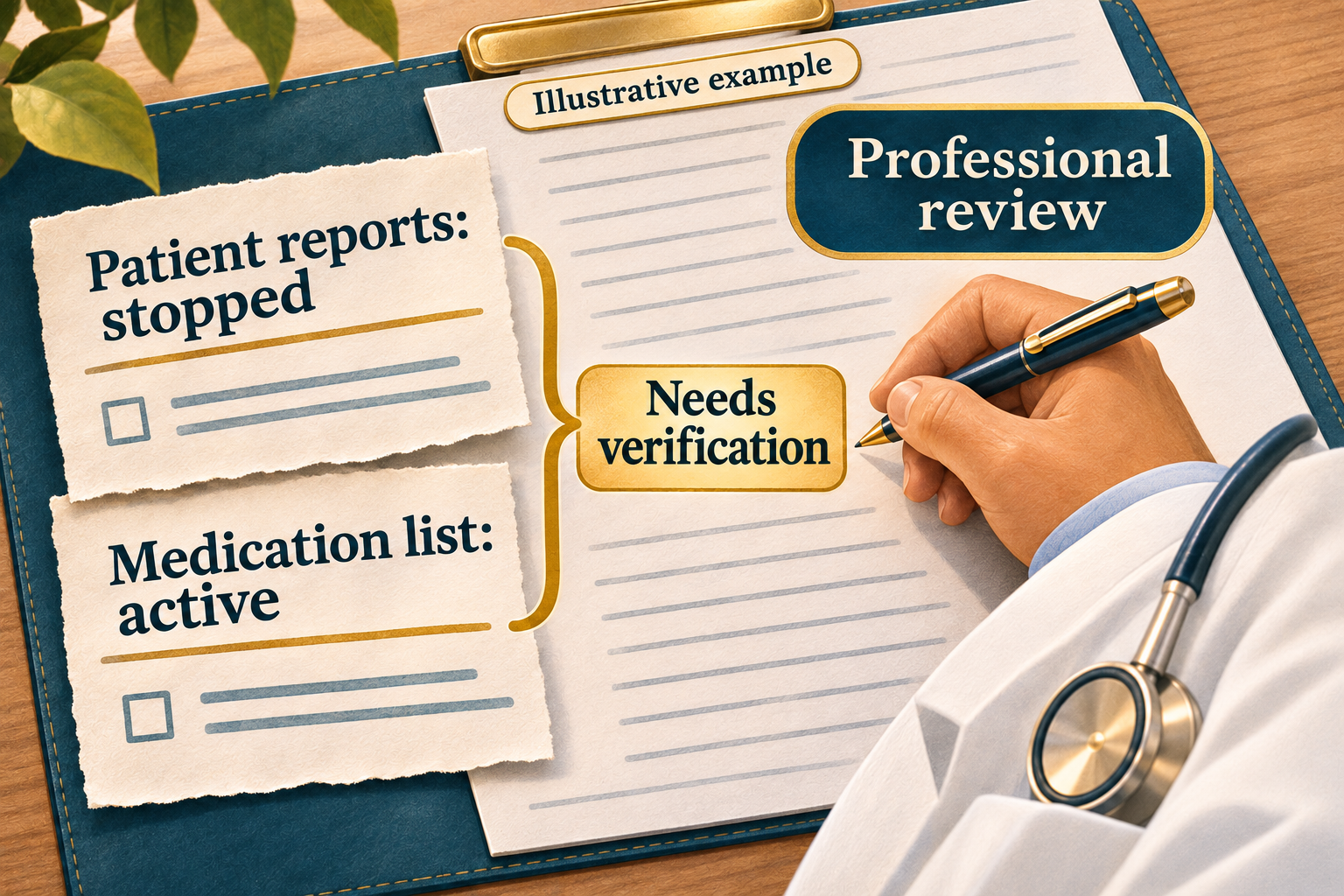
Illustrative example: a discrepancy is ready for review, not a decision to continue or discontinue treatment.
During the visit: verify the inputs and complete the clinical work
The responsible professional reviews and corrects the prepared information, prioritizes proposed screenings, and completes the applicable assessments. Obtain the required measurements and perform cognitive assessment separately from AI preparation. Address clinical findings and referrals rather than treating a completed questionnaire as the end of the work.
For the conflicting medication entry, the professional checks the available information with the patient and resolves what belongs in the current list. That verified account carries into the history and any relevant advice or follow-up.
Use the AWV Workflow and Component Checklist to keep preparation, required visit work, conditional reviews, and optional services distinct.
Before the billing handoff: approve the plan and verify completion
Review and approve the final screening schedule, personalized advice, and referrals. Give the patient a usable prevention plan and identify who will handle follow-up. Keep the reviewed record and unresolved items clear so the billing team can distinguish completed work from a draft.
An AI-generated note or plan is not proof that the underlying service occurred. The billing handoff still needs support for the selected visit, the furnishing professional, completed elements, and any separately reported service.
What pharmacy partners can contribute
Pharmacy partners can help practices obtain current medication and supplement information, identify discrepancies, and coordinate follow-up within the permitted service arrangement. AI-assisted preparation can organize those inputs for professional review; it does not change who is authorized to furnish or bill the AWV.
CMS identifies physicians, qualifying non-physician practitioners—physician assistants, nurse practitioners, and clinical nurse specialists—and qualifying medical professionals or teams working under a physician’s direct supervision. Pharmacists are not added to the independent non-physician practitioner category by the AI guidance. Pharmacy-supported work must fit the applicable scope, supervision, setting, and billing requirements. [1, 2]
The useful handoff is specific: what the patient or pharmacy reported, what differs from the chart, and what needs the practice’s decision. It should not represent an unreviewed medication list as a completed AWV or an independent pharmacy claim.
Existing AWV billing requirements still apply
The CMS page continues to identify G0438 for the initial AWV and G0439 for subsequent AWVs. Its AI annotations introduce no AI-specific billing code or separate payment for generating a questionnaire, summary, or prevention-plan draft. Eligibility, frequency, furnishing, and documentation requirements still apply. [1, 2]
Optional services also retain their own requirements:
- Advance care planning: AI can help prompt a voluntary discussion, but it does not supply the professional conversation or establish billable time for 99497 or 99498. CMS’s ACP fact sheet calls for documenting voluntary participation, the discussion, participants, and qualifying discussion time. Treating AI prompts or drafting alone as insufficient follows from those service requirements; the fact sheet does not contain an AI-specific billing rule. [1, 7]
- Physical activity and nutrition risk assessment: G0136 describes a standardized, evidence-based assessment, not HRA administration or AI drafting. CMS gives no separate AI-role annotation for this optional assessment in either AWV table. [1]
- Same-day evaluation and management: Separate reporting requires a significant, separately identifiable, medically necessary service. AI output alone does not establish that work. [1]
For code selection, add-on requirements, modifiers, and claim-readiness checks, use the AWV Codes and Billing Operational Reference.
AWV findings still need a separate care-management review
An AI-assisted AWV may help organize information that points to a follow-up need. It does not establish eligibility, consent, medical necessity, or completed services for remote patient monitoring, remote therapeutic monitoring, chronic care management, or advanced primary care management.
Use Integrating AWV with RPM, RTM, CCM, and APCM to separate the AWV finding from the other program’s requirements and avoid counting the same work twice.
Sources
- CMS: Annual Wellness Visit. First and subsequent AWV component tables; coding and billing; optional ACP and physical activity and nutrition risk assessment sections. Rechecked through live web research November 26, 2026; displayed page modification date: November 25, 2026, 12:17 PM.
- 42 CFR § 410.15: Annual wellness visits providing Personalized Prevention Plan Services. Coverage conditions, visit components, HRA, cognitive assessment, and health-professional definitions. Rechecked November 26, 2026; displayed current through November 24, 2026.
- CDC: A Framework for Patient-Centered Health Risk Assessments. 2011. Full framework, particularly self-report and accessibility discussion. General HRA guidance, not evidence validating AI administration.
- Evaluating large language models for drafting emergency department encounter summaries. PLOS Digital Health, June 17, 2025. Original single-institution study; the results cited concern 100 test encounters and the studied GPT-4 configuration, not AWVs.
- NIST: Artificial Intelligence Risk Management Framework—Generative Artificial Intelligence Profile. NIST AI 600-1, July 2024. Suggested action MS-2.5-003 addresses reviewing and verifying output sources and citations. Voluntary, cross-sector guidance.
- HHS: Guidance on HIPAA & Cloud Computing. Business associate status, agreements, risk analysis, and safeguards for cloud ePHI arrangements.
- CMS: Advance Care Planning. MLN909289, March 2026. Professional discussion, documentation, time, and billing requirements.
The CMS webpage provides official component and billing guidance; it is not itself a new regulation. Its displayed modification date does not establish when the AI language first appeared. Sources checked November 26, 2026.