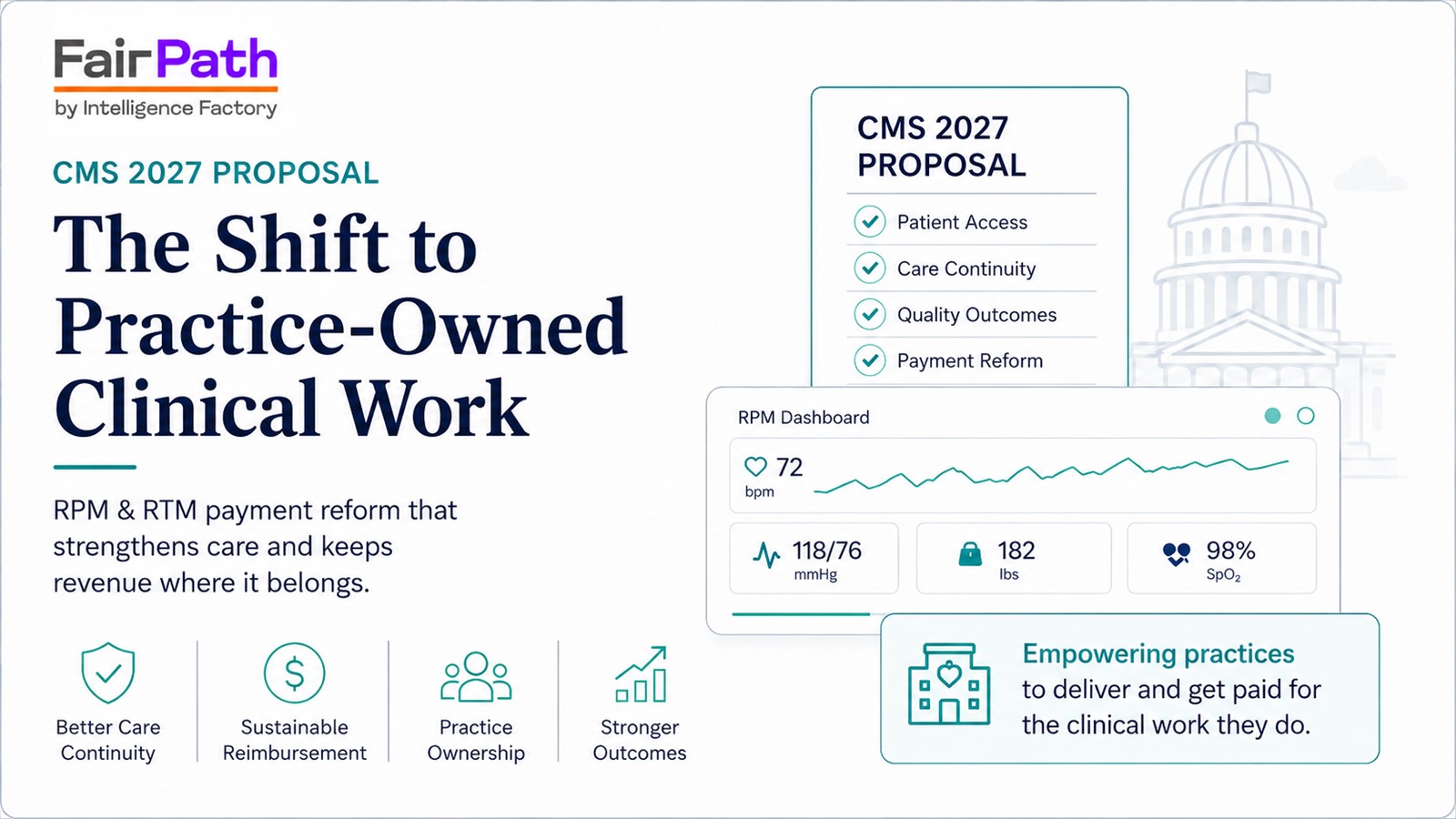
If your practice is considering bringing Remote Patient Monitoring (RPM) and Advanced Primary Care Management (APCM) in-house, the question is not whether you need another company to manage your patients. It is whether your own team has the tools to do the work efficiently.
Your clinicians already know the patients. They make treatment decisions, manage medications, and coordinate follow-up. Bringing RPM and APCM in-house lets you build on those relationships instead of placing a third-party clinical team between your practice and the people you care for.
FairPath gives your team one place to manage readings, check chronic-condition eligibility, build care plans with AI assistance, communicate with patients, and track program requirements. You buy the software—not an outsourced clinical workforce or a percentage-of-collections arrangement.
Bring the Work In-House Without Bringing Back the Spreadsheets
Practices often turn to an outside vendor because running RPM or APCM sounds like another administrative burden. Someone has to identify patients, handle enrollment, review readings, maintain care plans, follow up, and prepare documentation for billing.
Those are real responsibilities. But outsourcing is not the only way to organize them.
With FairPath, your team can see the patient’s readings, communication history, program status, and outstanding work together. Staff can pick up the next action without searching across a device dashboard, a spreadsheet, and a separate messaging system.
The work stays with your practice. The platform helps your team keep it organized.
Let Your Team Manage APCM and RPM Together
A third-party RPM service may focus on device readings. Your practice is responsible for the whole patient.
That is why APCM and RPM make sense in the same workflow. RPM brings in information from home. APCM connects that information to the patient’s broader primary care needs, care plan, and ongoing relationship with the clinical team.
Consider a patient with hypertension and diabetes. A change in blood-pressure readings may lead your team to discuss medication use, symptoms, or barriers to following the care plan. In FairPath, the readings and that follow-up belong to the same patient record. Your team can see the context, decide what to do, and document the next step without handing the patient off to a separate service.
Check Chronic-Condition Eligibility Without Reviewing Every Chart From Scratch
One of the first questions when bringing a program in-house is: “Which patients should we start with?”
FairPath has built-in chronic-condition eligibility checking that maps recorded diagnoses to APCM and RPM program capabilities. Your team can use that information to identify candidates, review program fit, and address missing information before enrollment.
You do not need a third-party vendor to own that process. Your practice can review its own patient population and decide where to begin, with software supporting the assessment.
Use AI to Help Build the Care Plan
APCM includes a patient-centered comprehensive care plan. That requirement can sound like a reason to outsource—especially if your staff imagines writing every plan from a blank page.
FairPath’s AI helps prepare a patient-specific care plan using the patient’s clinical summary and selected clinical pathways. The workflow supports goals, interventions, tasks, and escalation instructions for the clinician to review and approve.
For patients receiving both APCM and RPM, the care plan gives monitoring a purpose: what the team is watching, what needs follow-up, and how the work supports the patient’s goals.
Your clinicians retain control of the plan. AI helps with the preparation, so their time can go toward reviewing and applying it.
Keep Patients Connected to Your Clinical Team
Bringing care management in-house should strengthen the patient’s connection to your practice—not create another phone number, another team, and another handoff.
FairPath supports your practice’s 24/7 access and communication workflow through connected calling, messaging, and patient records. Conversations stay linked to the readings and care-management information your team needs to understand them.
Your practice establishes clinical coverage and response arrangements. FairPath supplies the tools that support that connection. You do not have to purchase an outsourced clinical service to use them.
See What Is Missing Before the Month Ends
An in-house program needs a clear view of what has been done and what still requires attention.
FairPath tracks APCM requirements alongside the patient workflow, including consent, care-plan information, access and continuity, and care coordination. Its AI assistant can assess individual requirements and provide recommendations for your team’s review.
RPM activity, readings, time, and communication remain connected to the patient record. Instead of reconstructing the month before billing, staff can work through specific outstanding items as they arise.
APCM and RPM retain their separate billing requirements. Medicare permits them together when each service’s requirements are met and the same time and effort are not counted twice. One workspace helps your team manage those distinctions without operating two disconnected programs.
Pay for Software, Not a Share of Your Clinical Work
When your practice performs the clinical work, a percentage-of-collections fee grows as your program grows.
FairPath does not take a percentage of collections. Your practice pays for the platform while retaining control of staffing, patient relationships, clinical decisions, and program operations.
That gives you a different way to expand: improve the workflow, add patients as your team has capacity, and keep the economics tied to how you operate—not to an outside vendor’s share of your collections.
Start With a Small In-House Cohort
You do not need to move your entire patient panel at once.
Start with a few appropriate patients. Assign responsibilities, establish coverage, and use FairPath to manage eligibility, enrollment, readings, care plans, communication, and monthly review. Learn what the work requires, then expand with your team.
You need clinical staff and a well-run workflow. You do not need a third-party clinical vendor to run RPM and APCM for you.
See how FairPath helps your practice bring care management in-house.