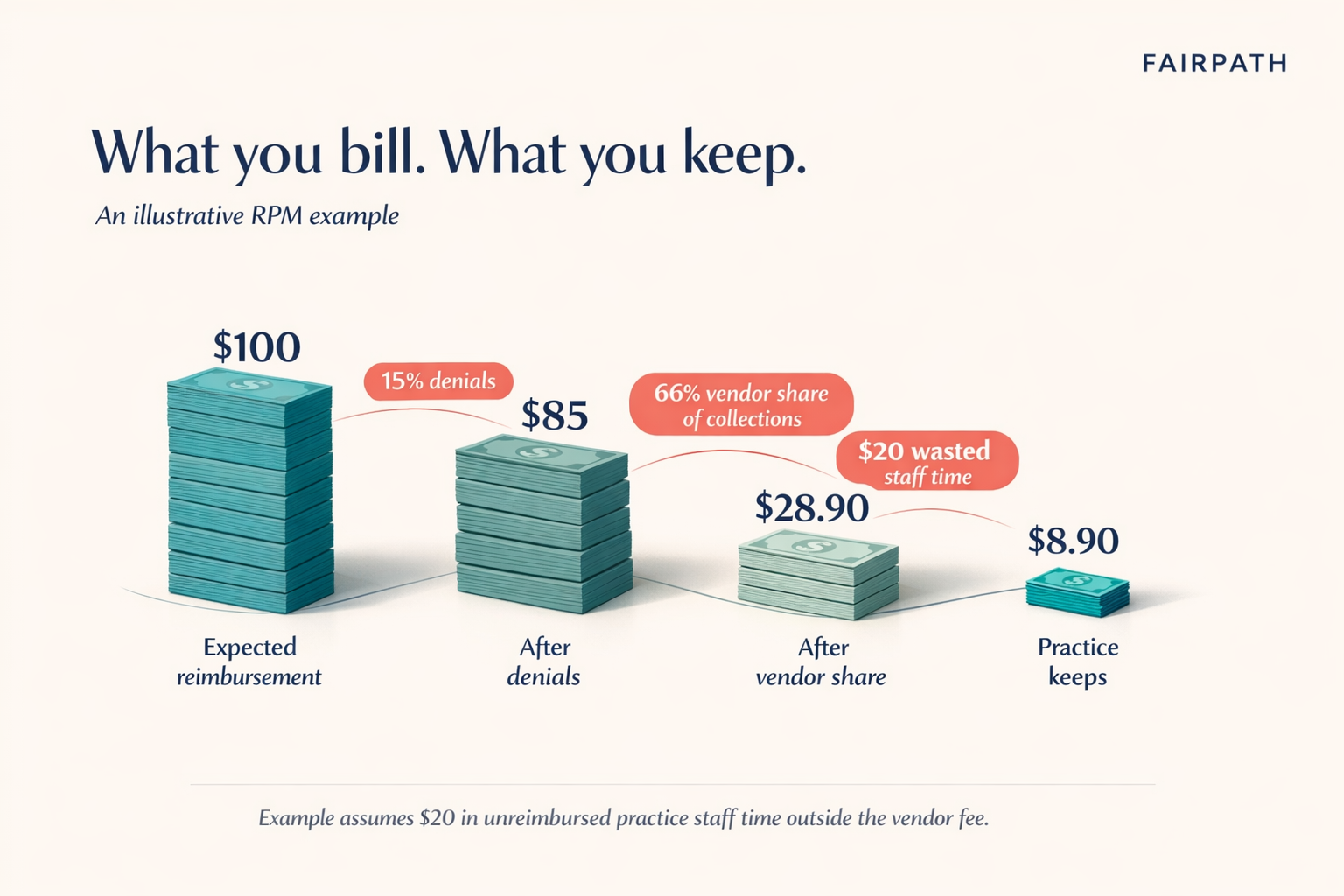
Every remote care program has costs. Outsourcing doesn't remove them; it folds them into someone else's fee.
Devices, clinical staff, patient outreach, documentation, billing, and follow-up all have to be paid for either way. What matters is how much of the program's revenue is left after those costs.
FairPath helps practices and pharmacy-led care teams keep more of it by cutting wasted clinician time, reducing manual work, and catching payment problems before they turn into expensive rework.
Where the vendor's share goes
The standard outsourced RPM model takes 50-70% of collected reimbursements, a large share of the revenue your patient relationships and clinical services generate.
For a program collecting $10,000 a month:
| Vendor share | Paid to the vendor | Remaining before your other expenses |
|---|---|---|
| 50% | $5,000 | $5,000 |
| 60% | $6,000 | $4,000 |
| 70% | $7,000 | $3,000 |
That fee may cover staffing, devices, and software. If you run the program yourself, those become separate line items. So compare the full operating model on each side, not a vendor's percentage against a software subscription alone.
FairPath doesn't take a percentage of collections. Your practice or pharmacy provides the clinical workforce and runs the program; FairPath supplies the software and AI that make the work easier to manage. You keep more of the revenue, and your team spends less time getting the work done.
Devices: a cheaper connection can cost more
For RPM, budget up to $180 per device, plus a small recurring cellular fee. Include shipping, setup, and replacements in the device budget. APCM and CCM don't require a monitoring device.
A cellular connection means fewer phone and app problems for your clinical team to troubleshoot.
| Cellular-connected device | Bluetooth-connected device |
|---|---|
| Sends readings over its own cellular connection | Usually sends readings through a paired phone or hub |
| Doesn't need the patient's smartphone or home Wi-Fi to transmit | The phone or hub has to stay connected and working |
| Fewer pairing, app, and phone-permission problems | Pairing, app settings, and dropped connections create support work |
Choose a cellular device with coverage where the patient lives. Then the patient's routine is simple: take a reading, and it uploads.
A lower device price stops looking like a saving once a clinician spends paid time troubleshooting connections instead of caring for patients.
The hidden expense: paid time with no reimbursement
Under RPM's traditional 20-minute management block, a clinician could spend 18 minutes reviewing readings, following up with a patient, and documenting care without reaching the first billing threshold. The clinician was still paid for those 18 minutes.
We cover this in The Hidden Pressure No One Talks About in RPM: What Happens at 18 Minutes.
The smaller RPM billing blocks introduced in 2026 shrink that gap but don't remove it. Time can still fall short of the next billable block, and work done after a billing limit still costs money without adding reimbursement.
The care itself is still worthwhile. The cost is paid clinician time that the program can't bill or recover through reimbursement.
Manual work adds to that cost: searching charts, sorting patient lists, assembling reports, and working out which patient needs attention next. APCM isn't billed in minute blocks, but that work still cuts into its monthly return. CCM is time-based, so unfinished billing blocks matter there as well.
Don't pad calls to fill a block. Organize necessary care so clinicians spend less time hunting for work and more time doing it.
In real deployments, FairPath cut wasted clinician time by 53%
FairPath's AI prioritization weighs patient needs, outstanding work, timing, and progress toward billing thresholds to set the next actions. Clinicians open a work queue instead of rebuilding a to-do list from charts and spreadsheets.
Our article on AI-driven patient prioritization explains the approach: the patients who need attention now rise to the top, so staff don't have to balance the whole panel by hand.
Here's what changes day to day:
| The question that eats staff time | What FairPath shows the team |
|---|---|
| Who should I call next? | A prioritized patient queue with the next action |
| Which patients need more readings this period? | Patients with missing readings and pending follow-up, while there's still time to act |
| What's happened since the last contact? | Readings, communication history, and AI-assisted patient summaries |
| What's still missing from the care plan or this month's work? | Care-plan tools and a list of requirements still to complete |
| How do I pull the month's work together? | Activity, time, and reporting records captured as the team works |
Your clinicians still deliver the care. They just spend less of the day figuring out where to start.
Catch missing readings before the period closes
Device-reading requirements are separate from clinical time blocks. Both get expensive when the team finds the shortfall too late.
For RPM devices, pausing a billing cycle to chase enough readings creates block gapping. Extending the cycle to capture more readings creates block stretching. Both distort the 30-day device period and create billing problems without fixing the missing readings.
The fix is earlier outreach, with the billing window left alone. FairPath flags patients who need more readings so staff can sort out a connection problem, answer a question, or remind the patient while the current period is still open.
Prevent payment problems instead of paying to fix them
A denied claim costs more than the lost reimbursement. Your team has already spent time enrolling, supporting, and caring for the patient. Then someone has to investigate and rework the claim.
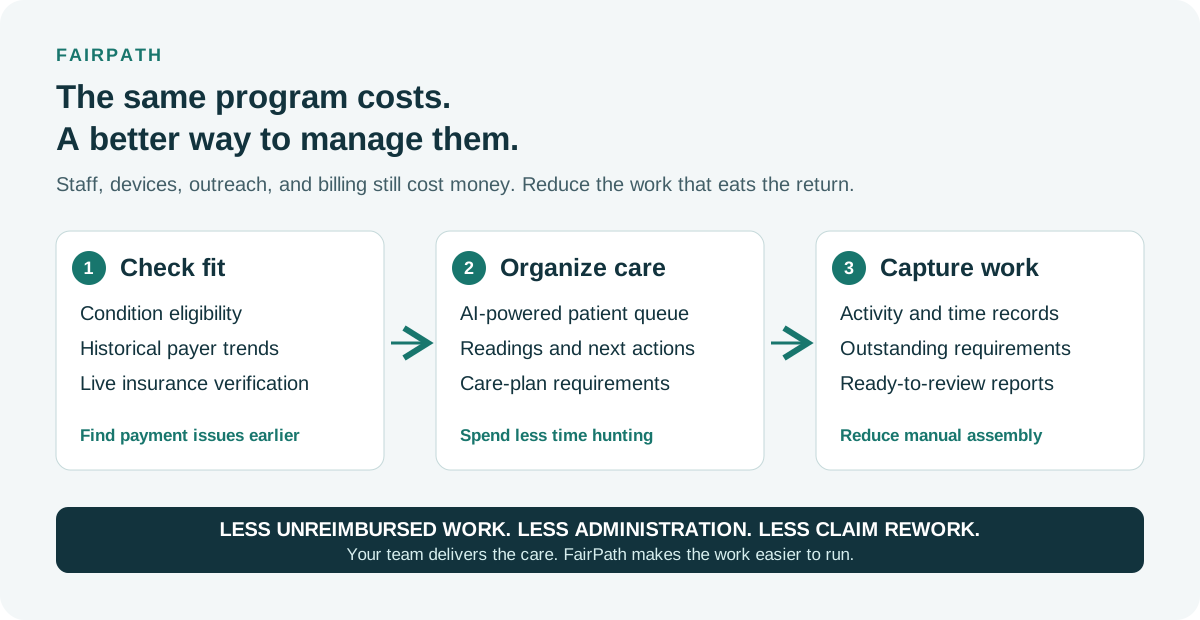
FairPath runs three checks early:
- Condition eligibility. It compares documented conditions with program eligibility, so the team can identify the right patients before investing in enrollment. Our guide to eligibility intelligence and pre-claim checks explains how it works.
- Historical payer payment patterns. It uses payer payment history to estimate the likelihood of reimbursement, so the team can see where payment problems are likely.
- Live insurance verification. It confirms current insurance information with the insurer, so the team isn't working from an outdated card or an old coverage record.
Fixing payment issues at the start costs less than fixing them after a denial.
Measure what the program keeps
Collected reimbursements - total operating costs = what the program retains.
Count the vendor's fee or your own staffing and platform costs, plus devices, connectivity, support, and billing. If the vendor fee already covers devices or staff, don't count them twice. Then look at the work behind those numbers: unreimbursed clinician time, connection troubleshooting, manual reporting, and denial rework.
Those costs apply whether you run a program for one practice or support several practices through a pharmacy. FairPath helps reduce them with eligibility checks before enrollment, an AI-prioritized work queue, automatic work capture and reporting, and earlier action on missing readings and requirements.
Moving the work in-house doesn't improve the economics of RPM, APCM, and CCM by itself. Giving your team a better way to do the work does.
See how FairPath brings remote care operations into one platform.