NEW FOR 2026: STABLE REVENUE WITH G0568-G0570

Stop Chasing RPM Minutes.
Start Building Stable Revenue.

RPM rules are getting harder. Payer coverage is shrinking. APCM is your safe harbor. FairPath helps you build a predictable, non-time-based revenue foundation across your entire Medicare panel—then layer RPM only where it’s safe and profitable.

STOP THE VENDOR TRAP

Traditional vendors take 60-70% of your revenue and own your patient data. FairPath is for practices who want to keep 100% of their margin, own their data, and sleep at night knowing their compliance is automated.

FairPath is the in-house remote care platform from Intelligence Factory, purpose-built for APCM, RPM, RTM, and CCM.

Calculate My Stable 2026 Revenue
$36.7M in reimbursements paid 335K+ patients protected 98% first-pass clean claims Zero clients hit with repayments Built by the team that bootstrapped one of America’s first profitable RPM companies

Practices just like yours finally stopped worrying

Real partners. Real results. Zero vendor headaches.

Your Current RPM Program is Built on Shaky Ground.

For years, practices were told to start with RPM, outsource everything to a full-service vendor, and treat APCM or CCM as an optional add-on. That worked until payers tightened RPM coverage and regulators started looking closely at rev-share models and documentation.

The Payer Rug-Pull.

Payers are narrowing RPM coverage to specific conditions and use cases. If your economics assume “RPM for everyone,” a single policy update can erase large chunks of expected revenue while your device and staffing costs stay fixed. When UHC cuts RPM coverage, that’s a rug-pull—not a rounding error.

Code Threshold “Gotchas”

RPM requires device data on most days of the month and documented interactive time to bill management codes. Miss a day or a time threshold and the claim evaporates, even though your team already did the work.

Full-Service Vendor Trap

Many full-service vendors take half or more of the reimbursement while the practice keeps the legal and reputational risk. You carry the audit exposure and patient relationship, they control the data and most of the revenue.

OPERATIONS & ADMIN

Manage 100 or 10,000 Patients with the Same Team

One operating system for APCM, RPM, CCM, and RTM—from eligibility and onboarding to billing, compliance, and scale.

The most common objection to bringing RPM, APCM, RTM, or CCM in-house is bandwidth. FairPath’s queue-based architecture lets you work as little or as much as you want: whether you have 30 minutes a day or a dedicated team, the system prioritizes work so you never waste time, eliminate repetitive manual steps, and keep the focus on patient health first.

Eligibility & Panel Design: Stop Guessing, Start Targeting

Most practices struggle with remote care because they improvise who to enroll. FairPath replaces guesswork with structured, scalable decision-making. We turn the chaos of payer rules, diagnosis codes, and payment history into a single 1–5 Qualification Score for each patient, so you see exactly who is viable for APCM, RPM, CCM, or RTM without manual chart review.

ERA & Payment Intelligence

Predictive payer scoring built from your own data. FairPath ingests your 835 (ERA) payment files to learn from your actual claims history, predicting which payers and codes will reimburse and filtering out high-denial plans before you ever start enrollment.

Condition-Level Mapping

One dashboard maps diagnoses to programs (e.g., HTN, Diabetes, COPD, CKD → APCM, RPM, CCM), showing which chronic conditions qualify for which programs in a single, simple table tuned to your clinical policies.

Always-Current Rules Engine

We automatically update the logic for CMS rules, insurance policy shifts, and ICD code changes (including ICD-11). Your eligibility scores and panel design never go stale as regulations evolve.

The Operational Shift: You never waste time chasing ineligible patients. Every enrollment minute is directed at a clinically appropriate, reimbursable candidate.

FairPath Eligibility Score Dashboard
The 1–5 Score consolidates clinical data and payer history into one number.

Structured Enrollment & Logistics

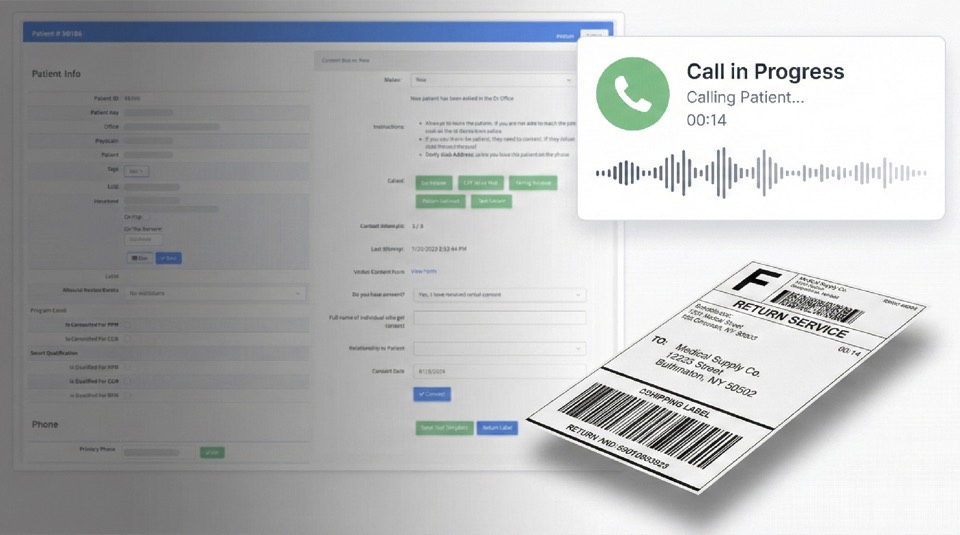
Move from “ad-hoc notes” to a structured, browser-based Onboarding Module. FairPath unifies communication, documentation, and hardware logistics in a single flow—staff call patients from the browser, capture verbal consent, and assign device serial numbers without spreadsheets.

Guided Outreach & Consent

Call patients directly from the browser using built-in onboarding scripts. FairPath delivers training materials and automatically records and transcribes verbal consent to the chart while simultaneously kicking off downstream logistics.

Device Inventory Control

Track serial numbers and assignments in one place—no separate trackers. Generate return shipping labels instantly and prevent billing for inactive or lost devices.

Document Automation

Send templated patient letters, save signed forms, and archive all training records in a single, audit-ready profile.

Onboarding Module

Daily Operational Command Center

Your operations team lives in PriorityQ and ReviewQ—consolidated queues that sort work by urgency, clinical risk, and code completion. Instead of reviewing every reading, your staff works from a single queue of exceptions: critical vitals, worsening trends, and “no data” patterns. The same interface works for 50 or 5,000 patients; only the queue length changes, with Nurse Amy handling routine nudges and troubleshooting in the background.

Unified Queues

Consolidates new readings, APCM service tasks, “Device Problem” events, and exception alerts into one prioritized list so every click advances both patient outcomes and billable progress.

Integrated Comms

Calls and texts are initiated from the queue. Every interaction is timestamped and attached to the patient record, feeding BillingQ and your audit trail automatically.

PriorityQ Operational View

BillingQ: The Pre-Flight Check

Make “Compliance-as-Code” real. BillingQ treats compliance as a systems problem, not a training problem—encoding the rules so risky claims never make it to your billing team.

  • Cross-Program Rules Engine: Understands how RPM, RTM, CCM, and APCM interact. Bundles APCM services correctly and enforces RPM’s structural rules (like 16 days of data) before a period is ever marked billable.
  • Embedded Regulatory Mapping: OIG red flags and MAC guidance are encoded directly into BillingQ. If a patient hasn’t met thresholds or components, the claim never appears in the “ready to bill” list.
  • Code Stacking & Bundling: Automatically flags conflicting codes (e.g., RPM + CCM overlaps) and ensures APCM bundles meet all service requirements before billing.
  • Automatic Time Tracking: Every interaction—calls, reviews, messages—is timestamped and categorized automatically, aggregating time toward the correct codes without manual tallies.
Audit Defense: Logs all readings, alerts, consents, and care-plan updates so you can answer OIG queries about “incomplete components”. No wasted motion—every action is tracked for reimbursement, and the system warns you if an activity won’t support a compliant claim, protecting both revenue and your license.
BillingQ Compliance Engine
Built-In SOPs & Governance

Don't reinvent the wheel. FairPath includes embedded operational procedures for enrollment, review, and QA, refined over millions of patient interactions.

Scalability without Chaos

The same operating model works for 100 patients or 10,000+. Queue-based workflows mean you scale by adding roles, not by rewriting software.

CLINICAL & PATIENT CARE

How FairPath Supports Clinical Care

Structured care pathways, AI-assisted drafting, and patient engagement that keeps clinicians in control—even as you scale from a few dozen patients to a multi-thousand panel.

The Blueprint: Evidence-Based Pathways

Remote care fails without a roadmap. FairPath provides Ontology-Driven Pathway Schemas that act as the clinical blueprint for your program—ensuring every patient receives consistent, high-quality care. Developed in partnership with leading clinicians and refined over millions of patient interactions.

AI-Assisted Drafting & Analysis

Nurse Amy analyzes patient history and comorbidities to draft a comprehensive care plan for you. She suggests goals, phases, and interventions based on your clinical guidelines—all within a secure, HIPAA-compliant environment.

Library or Custom Guidelines

Draw from our library of best-practice schemas (HTN, Diabetes, COPD), or encode your own proprietary protocols.

Multi-Condition Management

Stop juggling separate plans. Create a single CarePlan that manages multiple chronic conditions at once. The system maps clinical activities to CMS billing rules automatically, ensuring documentation meets APCM thresholds by design.

Full Clinical Audit Trail

Track every development. FairPath audits every change to the care plan, creating an immutable history of patient progress and provider decision-making.

FairPath Care Plan Interface showing multi-condition pathways
Care plans are generated from structured schemas, ensuring clinical consistency across your panel.

Your Clinical Workspace — Work Only Where It Matters

The Priority Q puts the most important patients in front of you first. Instead of reviewing every reading or bouncing between charts, clinicians work from a single queue of exceptions—critical vitals, worsening trends, and “no data” patterns. AI evaluates incoming readings in real time so you decide how hands-on you want to be, and the software absorbs the rest.

AI Triage & Scheduled Events

Critical alerts jump to the top. Scheduled follow-ups for CCM and APCM appear automatically when due. Filter by event type or let the AI decide what's next so your effort is defined by clinical need, not panel size.

Instant Billing Progress Bars

Watch billing codes track in real-time. As you log time or complete tasks, progress bars fill up instantly so you know exactly when thresholds (like CCM 20 mins) are met.

Integrated Click-to-Call & SMS

Call or text patients directly from the chart or queue. Every attempt is automatically logged to the audit trail and contributes to time tracking.

AI Scribe & Auto-Transcription

Stop typing. FairPath automatically transcribes and summarizes every phone call. You can also dictate your own clinical notes. Both the original audio and transcript are saved in a HIPAA-compliant archive.

Clinical Patient Review
One screen for readings, care plans, and billing progress.

"Nurse Amy" Patient Engagement

Nurse Amy is an embedded capability of FairPath—not a separate product. She handles routine friction so your clinicians can focus on complex care: sending nudges to keep patients on track for RPM requirements (like 16 days of readings), troubleshooting connectivity, and delivering structured symptom surveys via text or voice.

Troubleshooting Icon
Device Support

Walks patients through fixing connectivity issues to keep data flowing.

Reminders Icon
Compliance Nudges

Reminds patients to take readings or complete APCM elements.

Surveys Icon
Surveys & Queries

Collects structured symptom data and answers common questions.

Escalation Icon
Smart Escalation

Recognizes clinical risk and hands off to human staff with context.

The Operational Shift: You choose how little or how much to personally touch; FairPath ensures that whatever reaches your staff is worth their time, defined by exceptions rather than panel size.

Backed by SemDB and OGAR guardrails to ensure HIPAA compliance and minimize hallucinations.

APCM Is the Stable Base for Remote Care

Advanced Primary Care Management (APCM) is a monthly bundle that pays you for proactive, between-visit primary care work across your Medicare panel. It is not a time-based RPM or CCM add-on; it is a foundational program that recognizes how your clinic already functions.

Monthly, Not Minute-Based

APCM pays per patient per month for meeting defined service requirements and maintaining capabilities, rather than chasing a specific number of documented minutes. Your team can focus on doing the right thing clinically, not watching a stopwatch.

Panel-Wide Eligibility

APCM is designed for a broad primary-care population. Instead of hand-picking a small subset of high-risk patients, you can extend structured, reimbursed support across your Medicare panel and stratify by complexity level.

Compatible With RPM & RTM

APCM is not an RPM replacement. It is a base you can bill consistently, while still layering RPM and RTM for the patients and payers where those services are appropriate and covered.

APCM-first means your recurring revenue is tied to primary care relationships, not device counts.

Learn More About APCM

The APCM-First Model in Practice

Instead of asking “which RPM vendor should we use?”, the better question is “how do we stand up an APCM foundation and then add RPM only where it makes sense?”. FairPath is built around that sequence.

Step 1
Map Your Panel

FairPath ingests your Medicare and MA panel, normalizes diagnoses, and maps each patient to an APCM level based on complexity. You see exactly how many patients could be enrolled and what that translates to in projected monthly revenue.

Step 2
Operationalize APCM Requirements

APCM requires capabilities like 24/7 access, care coordination, and risk-stratified management. FairPath turns those into concrete workflows, templates, and a monthly service-element ledger that doubles as your audit trail.

Step 3
Layer RPM Only Where It Fits

Once APCM is live, you selectively add RPM and RTM for the patients and payers where coverage and clinical need align. FairPath encodes payer rules and threshold logic so you do not submit codes that fail policy requirements.

Automate the Complexity. Keep the Revenue.

FairPath is not another outsourced vendor. It is the software stack that lets your team run APCM, RPM, RTM, and CCM in-house with zero cognitive load: payer rules and code-stacking guardrails are automated so you can focus on patients instead of memorizing policy updates.

Eligibility & Panel Intelligence

FairPath reads eligibility data and payer information to distinguish Original Medicare, Medicare Advantage, commercial, and Medicaid plans. It surfaces APCM and RPM eligibility at the patient level so your team knows who can be enrolled and under which program.

APCM Service-Element Ledger

Every month, FairPath tracks which APCM requirements were met for each patient and keeps a structured log of outreach, coordination, and follow-up. Claims only go out when the underlying record meets your compliance criteria.

Priority Q Command Center

One queue for your remote-care team: which patients need outreach today, which APCM months are incomplete, which RPM patients are short on device days, and which claims are ready to bill. No spreadsheets, no swivel-chairing between portals.

Compliance-as-Code Guardrails

FairPath enforces program and payer rules in software: code-stacking constraints, time and day thresholds, and program concurrency. High-risk combinations never make it onto a claim file in the first place. G0568-G0570 add-ons are handled automatically so your team does not carry the new 2026 rules in their heads.

Who APCM-First Is For

This model is not for everyone. It is for practices that want control of their program, their data, and their margins, and are willing to run remote care as part of their core clinical operations instead of outsourcing it to a black box.

Independent Primary Care Groups

Groups that want durable Medicare revenue, clean auditability, and a way to extend care between visits without betting everything on a single RPM vendor contract.

Multi-Site & Value-Based Organizations

Clinics preparing for value-based contracts and quality metrics, and who see APCM as the connective tissue between in-person visits, telehealth, and remote monitoring.

Practices Leaving Full-Service RPM Vendors

Teams that have seen how rev-share models and offshore call centers erode margin and patient trust, and want a way to bring remote care back in-house on their own terms.

Common Questions About APCM-First

These are the questions that come up in nearly every APCM conversation. The short answers are here; the detailed answers live in your implementation plan and payer-specific policy review.

Can we bill APCM and RPM for the same patient?

Often yes, provided each program’s requirements are met and payer policy allows it. The key risk is stacking codes or billing RPM where the payer has narrowed coverage. FairPath encodes those rules so your billing exports reflect what is actually allowed.

What does APCM require from our team?

APCM expects structured, proactive primary care: accessible communication, care coordination, risk-stratified management, and ongoing care plans. FairPath turns those requirements into daily workflows and a monthly ledger instead of a vague list of obligations.

Do we need to hire a new team?

Most practices start APCM-first with their existing staff and clear workflows. FairPath’s automation (including AI-driven outreach and triage) is designed to extend your team rather than force you to build a separate call center.

What if we are already running CCM or PCM?

APCM interacts with other care-management codes in specific ways. For some patients, APCM will replace older codes; for others, specialized programs may continue alongside. FairPath provides a migration map and enforces stacking rules in software so your team does not have to memorize every combination.

Test APCM-First in Your Practice

APCM is already live. Payers are already tightening RPM. You can either wait for your current vendor to adjust, or you can build a remote-care stack that starts with durable APCM revenue and uses RPM and RTM surgically instead of universally.

Grab these free resources before you go

2026 OIG Audit Survival Guide

23 must-have items that saved our clients millions.

Download free →

Get Your RPM Fraud Risk Report

See the CMS/OIG billing signals for your program and the optimization fixes to get ahead of an audit letter.

Request my report →

How to Fire Your RPM Vendor Without Losing Patients

Exact timeline + email templates we use.

Download template →