Picture Mary, 62, balancing a job and early diabetes. Her doctor, Dr. Patel, is her anchor—reviewing labs, coordinating with a nutritionist, tweaking her care plan. But until 2025, Dr. Patel wasn’t paid for this invisible work. It was just “what doctors do.” If you’re in healthcare, you’ve lived this. The system rewards visits, not care. Then came Advanced Primary Care Management (APCM) codes, a bold shift that’s rewriting the rules of primary care. Better yet, artificial intelligence (AI) is making it easier to seize this moment. Let’s talk for a minute about why APCM matters, how it works, and what it means for you…no hype, just the basics in black and white. Below is a practical breakdown of what this means and what to do next.
The Old Way: CCM’s Narrow Lens
Chronic Care Management (CCM) tried to fix this. It paid providers to coordinate care for patients with two or more chronic conditions, like diabetes and heart disease. But it was limited. If Mary had just one condition, Dr. Patel’s late-night calls to specialists went unreimbursed. And the paperwork? A slog. CCM required logging 20 minutes of non-face-to-face care per patient monthly, and documentation/eligibility issues are a common reason programs see denials. CCM was a spark, but it wasn’t the fire we needed.
APCM: A New Era for Care
Enter APCM codes (G0556, G0557, G0558), launched by CMS in 2025. These codes cover all Medicare patients—whether they have no chronic conditions or a dozen. They shift the focus from reactive fixes to proactive care, paying providers to be the hub of a patient’s health journey. Here’s how they break down:
- G0556 : Often used for patients with one or no chronic conditions, like Mary’s early diabetes. It’s about prevention and early action.
- G0557 : Often used for those with multiple chronic conditions, building on CCM with a more comprehensive primary-care operating model.
- G0558 : Commonly used for Qualified Medicare Beneficiaries (QMB) with more complex needs.
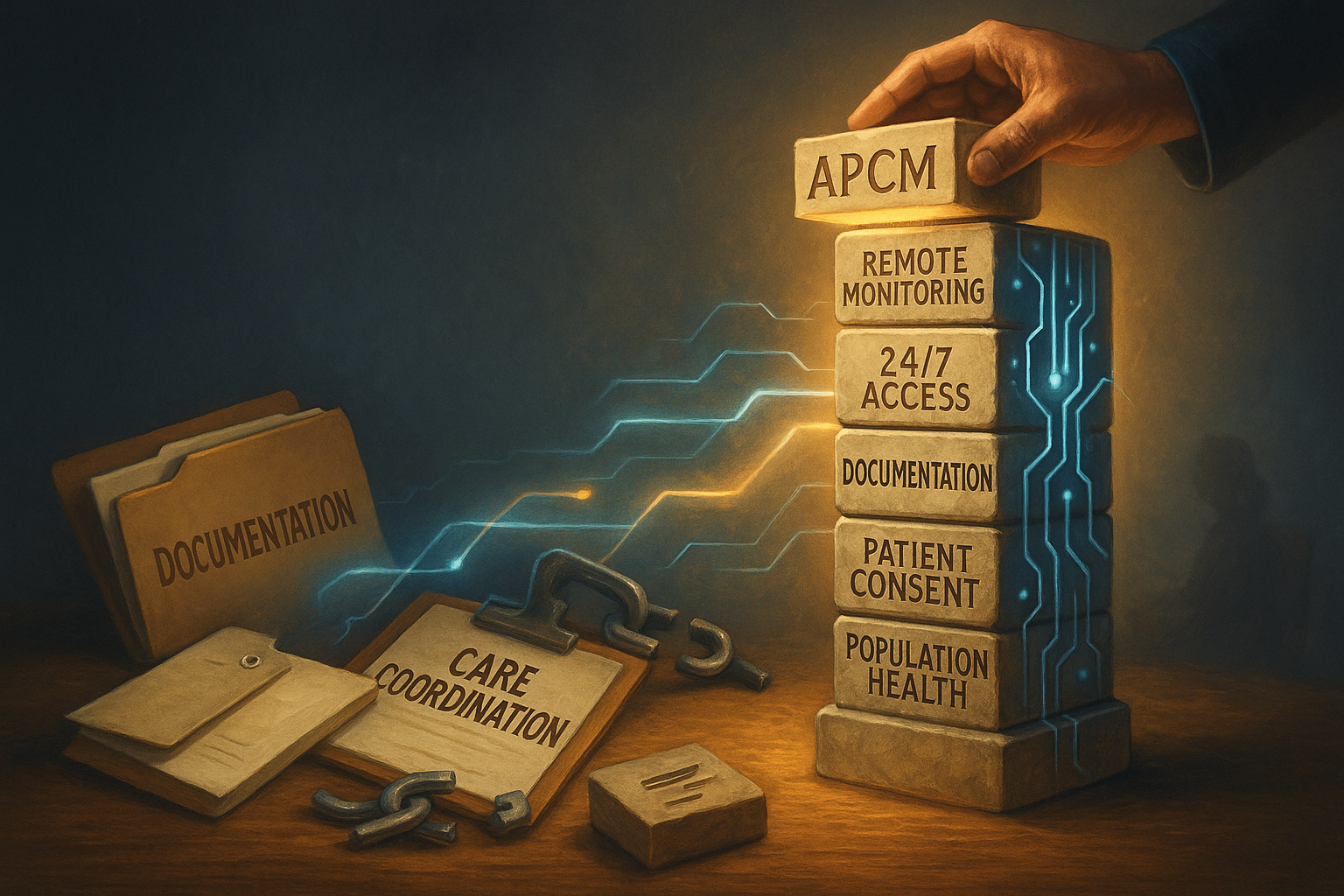
Unlike CCM’s minute-by-minute tracking, APCM uses monthly bundled payments. Providers must coordinate care, ensure 24/7 access, and meet 13 service elements—like electronic care plans and population health analysis. Payment rates vary by locality and setting, so treat any dollar figures you see online as illustrative and confirm your rates in the CMS Physician Fee Schedule. Tied to CMS’s value-based care push through models like ACO REACH and MIPS’s Value in Primary Care pathway, APCM is a bridge to the future. It’s care that pays off—for patients and practices.
The Challenge: Coordination Is Hard
APCM sounds great, but it’s not a walk in the park. Dr. Patel isn’t just treating Mary; she’s syncing with specialists, tracking social factors like food access, and documenting everything. CMS demands patient consent, care plans, and performance reports. Many practices struggle with coordination because staffing and workflow design rarely match the reality of longitudinal care. Mess up the paperwork, and you’re facing audits or lost revenue. It’s a heavy lift—but it’s also a chance to shine.
AI: Simplifying the Complex
Here’s where AI becomes your ally, quietly tackling APCM’s toughest demands. It’s not about replacing you—it’s about cutting the noise so you can focus on patients. AI streamlines the chaos of care coordination and compliance in practical ways:
- Seamless Documentation : AI pulls data from EHRs, patient portals, and call logs to record care activities—like Dr. Patel’s emails or care plan updates—so teams spend less time on rework and fewer activities fall through the cracks.
- Proactive Care Gaps : AI analyzes patient data to flag gaps, like missed screenings or medication lapses, meeting APCM’s population health requirements. It’s like a second set of eyes, catching what busy teams miss.
- Enhanced Monitoring : APCM can pair with Remote Patient Monitoring (RPM) when clinically appropriate. AI can help triage signals from wearable data, alerting providers to issues like Mary’s glucose spikes and supporting timely outreach.
With APCM’s wider reach, the potential upside is real—but it only shows up when the workflow is designed to produce auditable, patient-specific evidence. AI doesn’t do the caring—it just makes it easier to do it well.
Mary’s Story: APCM in Action
Let’s revisit Mary. Dr. Patel enrolls her in G0556. AI tracks 10 minutes reviewing labs, 5 minutes emailing a nutritionist, and 5 minutes updating her care plan—all automatically, no spreadsheets needed. When Mary’s wearable flags a glucose spike, AI alerts Dr. Patel, who adjusts her meds over a quick call. That move prevents a hospital stay, and Dr. Patel’s practice gets paid for keeping Mary healthy. This is APCM: care that’s proactive, paid, and personal.
Why This Matters: Trust and Fairness
APCM isn’t just about revenue—it’s about trust. Patients like Mary want a doctor who’s their guide, not a gatekeeper. APCM pays you to be that anchor, strengthening relationships. It’s also about fairness. Rural clinics and FQHCs can bill APCM, serving communities where 20% of Medicare patients lack steady care, per CMS data. This is healthcare that includes everyone.
Zoom out, and APCM is a stepping stone to value-based care. As fee-for-service fades, models like MSSP and MIPS will take over. Providers who embrace APCM now will lead the pack, while others play catch-up. It’s a chance to shape the future, not just survive it.
The Fine Print: AI’s Realities
AI isn’t a silver bullet. Costs vary widely by vendor and deployment model, and staff need training and governance to trust what they see. HIPAA compliance and clear audit trails are non-negotiable. You’re still the decision-maker; AI just helps surface the data and structure the work. Start small, prove reliability, then scale.
Your Next Move
You don’t need to overhaul your practice to join this revolution. Try these steps:
- Audit Your CCM : Check last quarter’s CCM claims. How many denials were documentation errors? This shows APCM’s potential.
- Build an APCM Checklist : List CMS’s 13 service elements—consent, care plans, 24/7 access. Get your team aligned.
- Test AI with 10 Patients : Use an AI tool to log care activities for a month. Compare revenue and time saved to manual methods.
- Leverage RPM : If you’re using RPM, add AI to analyze data and meet APCM’s monitoring rules. It’s a double win.
A practice that piloted AI for CCM saw a revenue boost in 90 days. APCM could blow a small revenue boost out of the water. If you start now, you'll see results by summer…or you will just miss out.
The Bigger Call
APCM codes are a quiet revolution, but they won’t wait. They’re your chance to get paid for the care you already give, to build trust with patients like Mary, and to lead in a value-based world. AI is the tool that makes it doable, letting you focus on people, not paperwork. So, what’s your first step? Audit your CCM, grab that checklist, or share this post with your team. I am available to answer any questions on your journey. Shoot me a message!
Related resources: Advanced Primary Care Management (APCM) Guide, APCM Readiness Checklist (2026).
Disclaimer: This article is informational only. Coverage, coding, and payment rules vary by Medicare Administrative Contractor (MAC), locality, and payer plan.