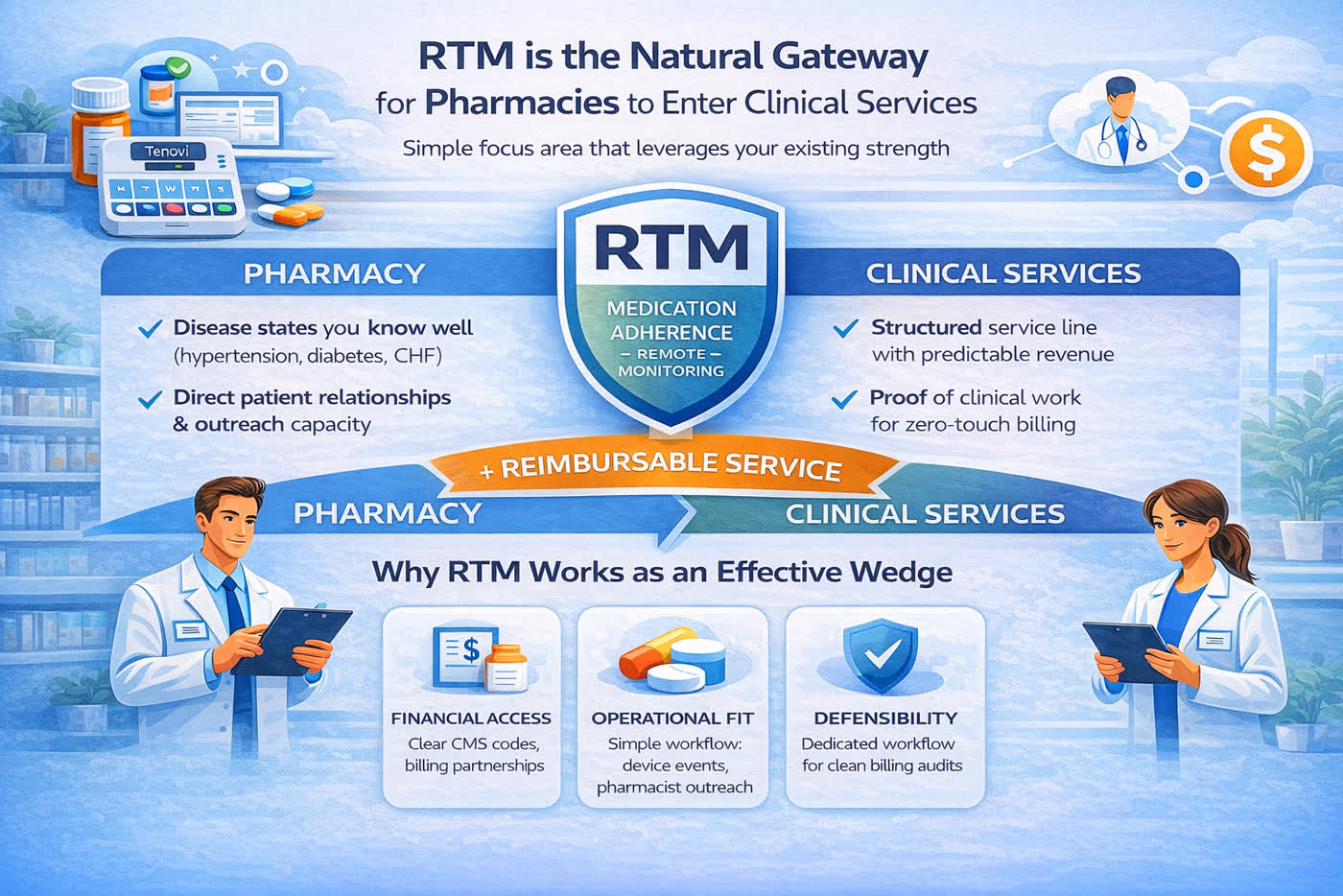
If you're a pharmacist thinking about building a reimbursable clinical services line, RTM is one of the cleanest places to start because medication adherence is already your surface area. The hard part is not the concept. The hard part is running it consistently at scale, without turning your day into manual review and month-end cleanup.
FairPath is built to run RTM as an operating program: intake, cohort setup, device workflow, exception routing, calling and documentation with proof, billing readiness, and month-end close. It is designed for pharmacy teams that want a business line they can grow past one or two clinicians without quality drift.
This article is informational and operational. Billing rules, supervision requirements, and payer coverage vary. Confirm specifics with your billing team or counsel.
What RTM is, in practical terms
Remote Therapeutic Monitoring (RTM) is remote monitoring for non-physiologic therapeutic data. In medication adherence programs, the "data" is not a blood pressure reading. It is adherence behavior and response: whether doses are being taken on time, whether a patient is falling off therapy, and whether intervention is needed.
RTM matters because it turns adherence into a structured program:
- capture adherence events through a device or app
- route exceptions to staff
- deliver interventions and education
- produce documentation artifacts as work happens
- close the month with clear billing readiness
FairPath supports this end-to-end workflow so your team is not stitching together device portals, dialers, documentation tools, and billing spreadsheets.
RTM vs RPM: the differences that matter to pharmacists
RPM is designed around physiologic data (blood pressure, glucose, weight) collected through medical devices. RTM is designed around therapeutic data such as adherence and therapy response.
A few Medicare distinctions are operationally important:
- Under Medicare rules, RPM requires an established patient relationship, while RTM does not.
- RPM and RTM cannot both be billed for the same patient in the same period.
- Only one practitioner can bill remote monitoring for a given patient per 30-day period.
For pharmacies, the practical takeaway is that RTM can be a more natural fit for adherence-first programs, while RPM tends to be more device-and-physiology centered.
How RTM reimbursement is typically structured
RTM reimbursement is generally organized around three buckets of work:
- setup and patient education
- device supply and data transmission thresholds
- monthly treatment management time with documented interaction
The key operational implication is that you need a real workflow, not a device alone. CMS guidance also notes remote monitoring can sometimes be billed alongside other care management services as long as time and work are not counted twice.
FairPath is built to keep that workflow clean: it routes exceptions, captures artifacts as care happens, and keeps billing readiness visible before month-end.
Can pharmacists bill RTM directly
There are two separate questions: Medicare fee-for-service and non-Medicare contexts.
Medicare fee-for-service
CMS remote monitoring guidance for Medicare emphasizes that remote monitoring billing is done by physicians and certain qualified practitioners, with services often furnished by auxiliary personnel under the required supervision structure. In practice, many pharmacy-led CCM and remote monitoring programs are structured through a billing provider partnership model for Medicare.
Medicaid and commercial plans
Direct pharmacist reimbursement is expanding in some states and payer contexts, which can open different operating models. For example:
- Maryland's SB 678 requires certain health plans and Medicaid to reimburse pharmacists for covered services within scope, and states reimbursement may not be conditioned on being employed by or acting under a physician's orders.
- Maryland Medicaid issued guidance that Medicaid-enrolled pharmacists may bill Medicaid for services within lawful scope of practice.
- Wyoming's Medicaid state plan amendment adds pharmacists as a recognized practitioner type allowed to charge for services.
These examples are not universal coverage guarantees. They do show the direction of travel: more jurisdictions are creating direct billing surfaces for pharmacist-provided services.
How FairPath supports both scenarios
Whether your RTM program is billed under a physician or qualified practitioner relationship, or you are operating in a context where the pharmacy can bill directly under applicable payer rules, the operational requirements are the same: a controlled workflow, clean artifacts, and month-end readiness. FairPath supports either structure. It is the operating system that runs the program and produces the proof and billing readiness you need, regardless of how your billing model is configured.
Tenovi adherence devices: IoT pillbox and smart pill cap
Medication adherence becomes operational when it is captured as timestamped events, not memory.
Tenovi offers two adherence device patterns commonly used in RTM programs:
Tenovi Smart Pillbox
A multi-compartment pillbox that detects open events and transmits adherence data through Tenovi's gateway and platform. Tenovi positions it as optimized for medication adherence monitoring and RTM workflows.
PatchRx PatchCap through Tenovi
A universal-fit smart pill bottle cap that detects open and close events and transmits medication event data through Tenovi's gateway and cloud. Tenovi explicitly positions this for RTM medication adherence monitoring.
FairPath can support Tenovi-based adherence workflows, and it also supports many other RTM device and data-capture options. The point is not the brand of device. The point is that device events must feed a program: exceptions, outreach, documentation artifacts, and billing readiness.
What an RTM adherence program looks like when it is done well
A program that scales past one or two clinicians needs five components:
- cohort definition: Pick a cohort where adherence intervention is clinically meaningful and operationally actionable.
- exception definition: Define what is "work." Programs fail when staff spends time reviewing noise.
- intervention workflow: What happens when a patient drifts: outreach, education, escalation, and follow-up.
- proof capture: Each intervention generates an artifact tied to the adherence event and patient context.
- month-end close: You can see what is ready, what is blocked, and why before month-end.
This is exactly what FairPath is designed to enforce. It keeps the day in-flow and keeps billing readiness visible in-cycle so the program does not degrade as volume grows.
FairPath as business-in-a-box for pharmacy-led clinical services
RTM is a strong wedge, but pharmacies rarely want "another platform." They want a new revenue line that is predictable and repeatable.
FairPath is business-in-a-box for these programs because it includes more than remote monitoring:
- cohort intake and patient list import to start quickly
- eligibility and coverage workflows as part of launch operations
- prioritized queues and exception routing so staff does the right work first
- integrated calling and messaging with transcription and scribe so proof is created as the work happens
- patient education workflows tied to touches and documentation
- billing readiness visibility before month-end
- claims output and reconciliation workflows for disciplined close
We do not provide clinical review staffing. You are still running the care. You are not left alone: training, playbooks, templates, and optional consulting are available to help you launch cleanly and scale without quality drift.
If you want to explore RTM for adherence in your pharmacy, the right next step is a small pilot cohort with a defined exception workflow and month-end readiness tracked in-cycle. FairPath is built to run that pilot and then replicate it to the next physician partner, clinic, or client practice.