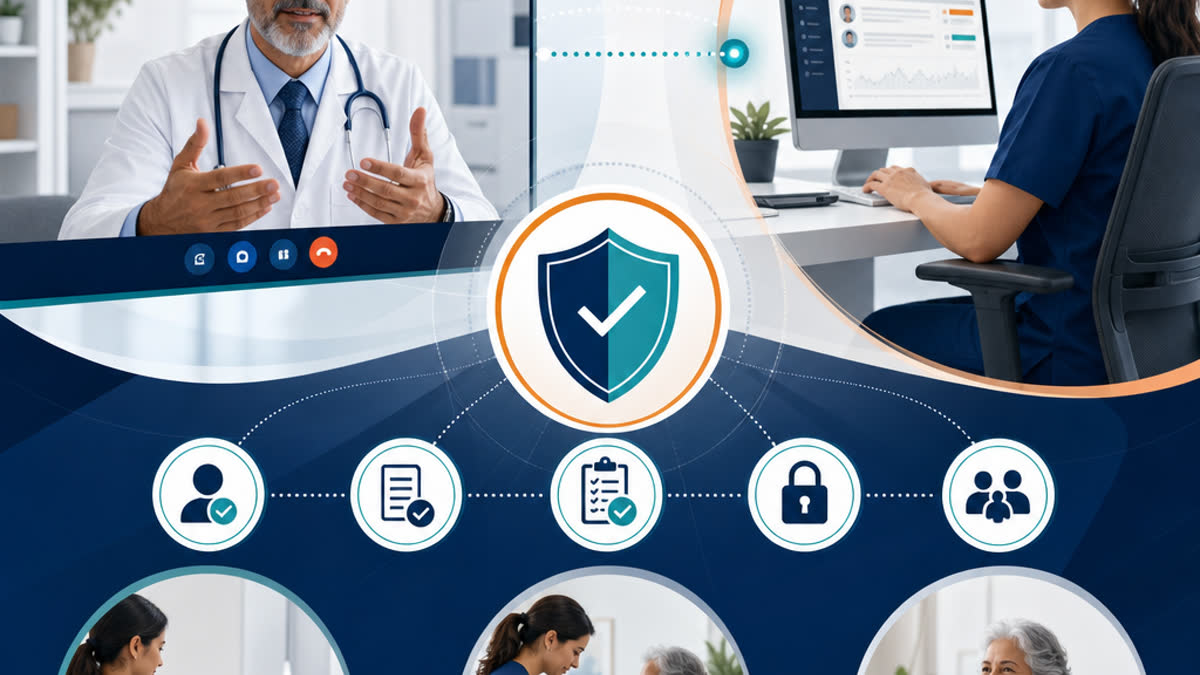
CMS permanently adopted virtual direct supervision for services furnished after December 31, 2025. That sounds like a green light for remote care management, but it is narrower than most practices think. It changes where the supervisor can be, not what can be done, who can bill, or how time rules work.
We just published a full operational guide on virtual direct supervision in Medicare for 2026 that covers the core rule, where it applies, common traps, and how to operationalize compliance. Below is a practical breakdown of what it means and what to do next.
The Core Rule
For applicable services furnished after December 31, 2025, CMS allows the required presence for direct supervision to include virtual presence via real-time audio-video communications technology. Audio-only does not qualify. The supervisor must be immediately available to intervene through a two-way audio-video connection.
This applies only where direct supervision is already required - incident-to services, certain diagnostic tests, and specific care management scenarios. It does not create new supervision requirements where none existed before.
What It Does Not Change
This is where practices get into trouble. Virtual direct supervision does not:
- Change who can bill the service
- Change what can be delegated to clinical staff
- Change scope-of-practice rules
- Eliminate the requirement that the supervising practitioner be immediately available
- Allow audio-only phone calls to satisfy the presence requirement
If your care management program was relying on "the doctor is on the phone" as a supervision model, that was never compliant for direct supervision, and it still is not.
Where It Matters Most for Care Management
For RPM, CCM, RTM, and APCM, the supervision rules vary by code and program. General supervision applies to some services (the supervising practitioner does not need to be on-site but must provide direction and control). Direct supervision applies to others (the supervising practitioner must be immediately available).
Virtual direct supervision gives you flexibility for the latter category - your medical director can be at home on a video call and still satisfy the immediate-availability requirement. But you need to document the supervision arrangement, the technology used, and the availability protocol.
Common Traps
- Audio-only as a substitute - phone calls do not qualify. You need real-time audio-video.
- Assuming it applies everywhere - it only applies where direct supervision is already required.
- No documentation of the virtual presence arrangement - if you cannot show how supervision was satisfied, you cannot defend the claim.
- Confusing virtual supervision with telehealth - these are different regulatory frameworks with different requirements.
The Bottom Line
Virtual direct supervision is a real operational enabler for practices with distributed teams or medical directors who are not physically on-site every day. But it is a narrow rule, not a blanket permission slip. Document your supervision model, use audio-video technology, and confirm which of your services actually require direct supervision before you rely on it.
The full guide with the core rule, program-by-program breakdown, traps, edge cases, and a planning checklist is at Virtual Direct Supervision in Medicare (2026).
Related resources: 2026 Billing Workflow Matrix: APCM + Behavioral Health + RPM/RTM, APCM Eligibility, Attribution, and Continuity, Remote Patient Monitoring (RPM) Guide (2026 Rules).
Disclaimer: This article is informational only. Coverage, coding, and rates vary by Medicare Administrative Contractor (MAC) and payer plan. Confirm payer-specific requirements with your billing team or counsel.